
Ionizing Bar Line Speed: Separate Web Width from Travel Time
When reviewing an ionizing bar for moving film, separate two directions on the drawing: the span across the web and the distance along its travel. Only the second belongs in a travel-time calculation. A worked example shows what this calculation can tell you before an application trial.
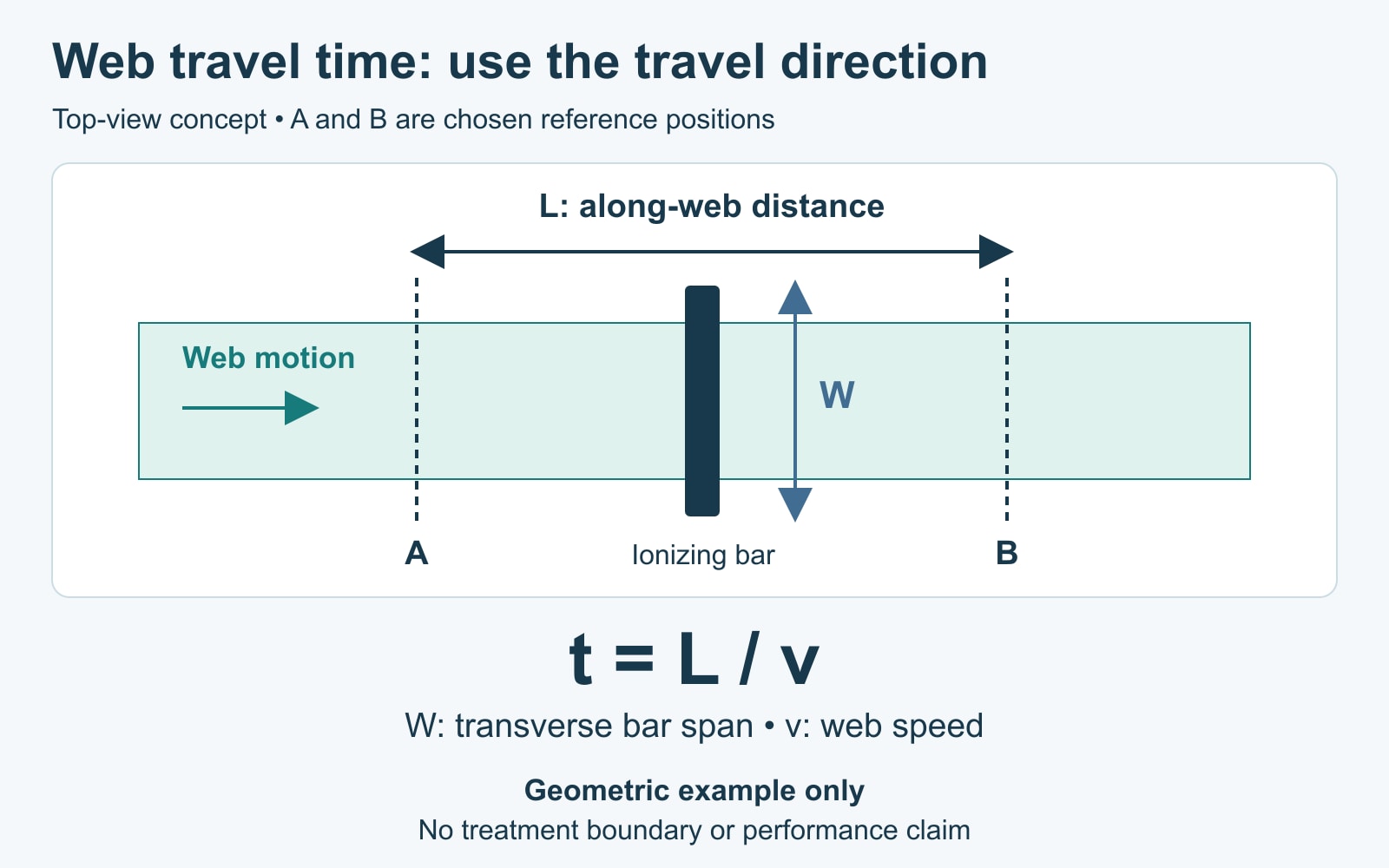
Original geometric diagram. A and B are reference positions, not measured boundaries of an ionization zone. No installation dimensions or performance results are shown.
Keep transverse span separate from travel distance
In this top-view example, the bar crosses the web. Its transverse span is labelled W. A point on the material moves from A to B along a different axis; that path length is L. Dividing W by line speed would time a distance the material point does not travel in this arrangement.
For a layout review, mark A and B on the drawing and state why those positions were chosen. Treat them as geometric references unless application evidence establishes something more. A bar drawing alone does not define a sharply bounded treatment footprint on the material.
Our ionizing-bar retrofit checklist covers body dimensions, active span and mounting information. Here, the narrower question is how to calculate travel between two stated positions.
Calculate time with consistent units
For a material point moving at constant positive speed v over path length L:
Travel time: t = L / v
Use metres and metres per second to obtain seconds. If speed is reported in metres per minute, divide that speed by 60 first.
Invented arithmetic example: choose an A–B path length of 0.10 m. At 30 m/min, the speed is 0.50 m/s, so the point travels from A to B in 0.20 s. These values are calculation inputs, not recommended dimensions or machine settings.
| Example | Path L | Line speed | Converted speed | Time L / v |
|---|---|---|---|---|
| First speed | 0.10 m | 30 m/min | 0.50 m/s | 0.20 s |
| Twice the speed | 0.10 m | 60 m/min | 1.00 m/s | 0.10 s |
The path stays unchanged, so doubling speed halves travel time. Increasing the bar's transverse span does not change either input in this calculation. For accelerating, stopping or reversing motion, a single nominal running speed does not describe the complete A–B transit; use the actual motion history or elapsed travel time.
Do not turn travel time into a line-speed rating
The calculation describes motion. It does not tell us the charge on the film at B, the ion balance of an ionizer, or how long adequate neutralization takes. Calling the A–B interval “dwell time” does not establish that useful ionization acts uniformly throughout it.
The public scope of IEC 61340-4-7:2025 separates ionizer measurements under specified conditions from qualification for a user's application. It identifies offset voltage and decay time as distinct measurements. This scope supports checking the actual application; it does not supply a maximum line speed for our example.
An independent charged-roll study by Wakatsuki and Sugimoto investigated a passive ionizer with air assistance. The researchers measured charge-elimination current at different roll movement speeds and charge potentials. That apparatus-specific investigation illustrates why a moving-target question needs more evidence than geometry alone; it is not a performance report for a Shidike bar.
Do not substitute a catalogue decay time for the calculated travel time and declare a passing speed. For reviewing the conditions behind those laboratory figures, see comparing ionizer datasheets.
Use the calculation to clarify an equipment request
Attach a marked drawing and a short calculation line to the application brief: “A = ___; B = ___; path length = ___ m; constant speed = ___ m/s; calculated travel time = ___ s.” Keep the transverse span on a separate dimension line.
Then ask the equipment and process teams what material measurements are needed at the intended operating speeds. Leave the application result open until that evidence exists. This makes the timing assumption reviewable without presenting a geometric estimate as demonstrated static-control performance.
Discuss your web path and intended speeds
Share the material, target face, marked path and operating-speed range when reviewing an ionizing-bar application with Shidike.
Explore Static Eliminators →Discuss your static-control application →