
Ion Transport and Recombination in Static Eliminators
An ionizer generates ions near its emitter, but the required result is at the material. Between those locations, transport and losses matter. An emitter-output claim therefore needs a separate working-position measurement before it can support a neutralization claim for an application.
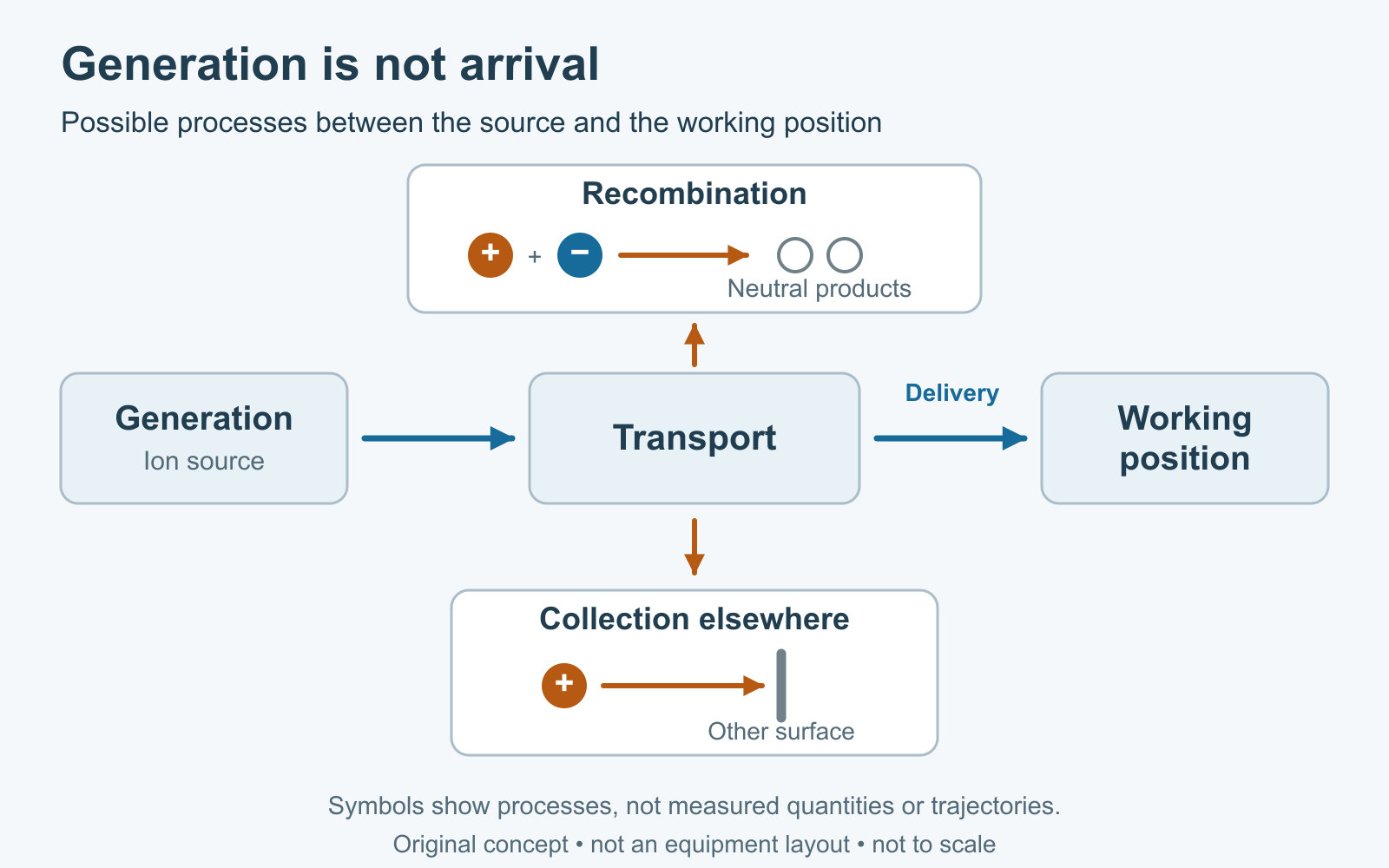
Original concept diagram. Symbols represent possible processes, not measured ion counts, loss fractions, trajectories or installation dimensions.
Separate ion generation from arrival
In an AC-ionizer experiment by Suzuki and Yosimizu, the researchers distinguished emitter current from current associated with ions reaching the working area. Their transport-efficiency definition compared arriving and generated ion quantities.
The distinction matters when reading a proposal: a source quantity and an arrival quantity describe different locations. The paper's particular apparatus and operating conditions do not establish a preferred frequency, airspeed or installation distance for a DGSDK product. Nor should an unspecified power-supply current be relabeled as delivered ion current.
Recombination happens between opposite ions
Positive and negative air ions can meet and become neutralized. That is ion–ion recombination: those charged carriers are no longer available to reach the intended material. Collection on another surface is a different route; the charge is transferred there.
Franchin and colleagues' CERN CLOUD study investigated recombination and treated surface collection and attachment to aerosol particles as other ion losses. The work concerns a controlled atmospheric chamber, not an industrial bar's performance. It supports distinguishing the mechanisms; it does not provide a loss percentage for your line.
Generation is one part of a connected process
The public abstract of Okano and colleagues' AC-ionizer modeling study describes generation, transport, accumulation and recombination as separate processes. Their simulation was compared with experiments over a defined frequency range.
This supports treating delivery as a system question, rather than ranking an installation from one source-output figure. It is not a general setting guide. For an application discussion, put the emitter, intended working position, nearby surfaces and actual air arrangement on the same drawing. Keep the proposed arrangement separate from what has actually been measured.
Connect the mechanism to a working-position result
IEC 61340-4-7:2025 covers ionizer offset voltage, or ion balance, and charge-neutralization decay time under specified conditions. Its public scope calls for qualification and verification appropriate to the application.
Bring those performance questions back to the proposed working position. Keep a residual-voltage reading on the customer's material identified as a material measurement; it is not the ionizer's ion balance. The ionizer datasheet comparison explains the separate test-condition questions.
A slow or uneven result alone does not identify recombination as its cause. The diagram explains possible processes, not a diagnosis from an unmeasured installation.
Keep each observation attached to its location
Use this blank record when a quotation, layout and test report appear to describe different locations. It is a discussion aid, not an adjustment procedure or certification form.
| Location or result | Information to retain | Your reference |
|---|---|---|
| Emitter/source | Which electrical or ion-output quantity was reported? | ___ |
| Delivery arrangement | Emitter and working-position drawing; nearby surfaces and air arrangement | ___ |
| Ionizer performance | Offset and decay results with method, position and conditions | ___ |
| Material observation | Material identity, measurement location and residual-voltage method | ___ |
Leave an unmeasured step open for the supplier or test engineer. For the broader application, see the static-prevention guide; for layout preparation, use the ionizing-bar retrofit checklist.
Discuss the working arrangement
Share the material, line layout, proposed ionizer position and available test record with Shidike. Identify the result you need at the material so the equipment discussion starts from the application.
Explore Static Eliminators →Discuss your static-control application →