
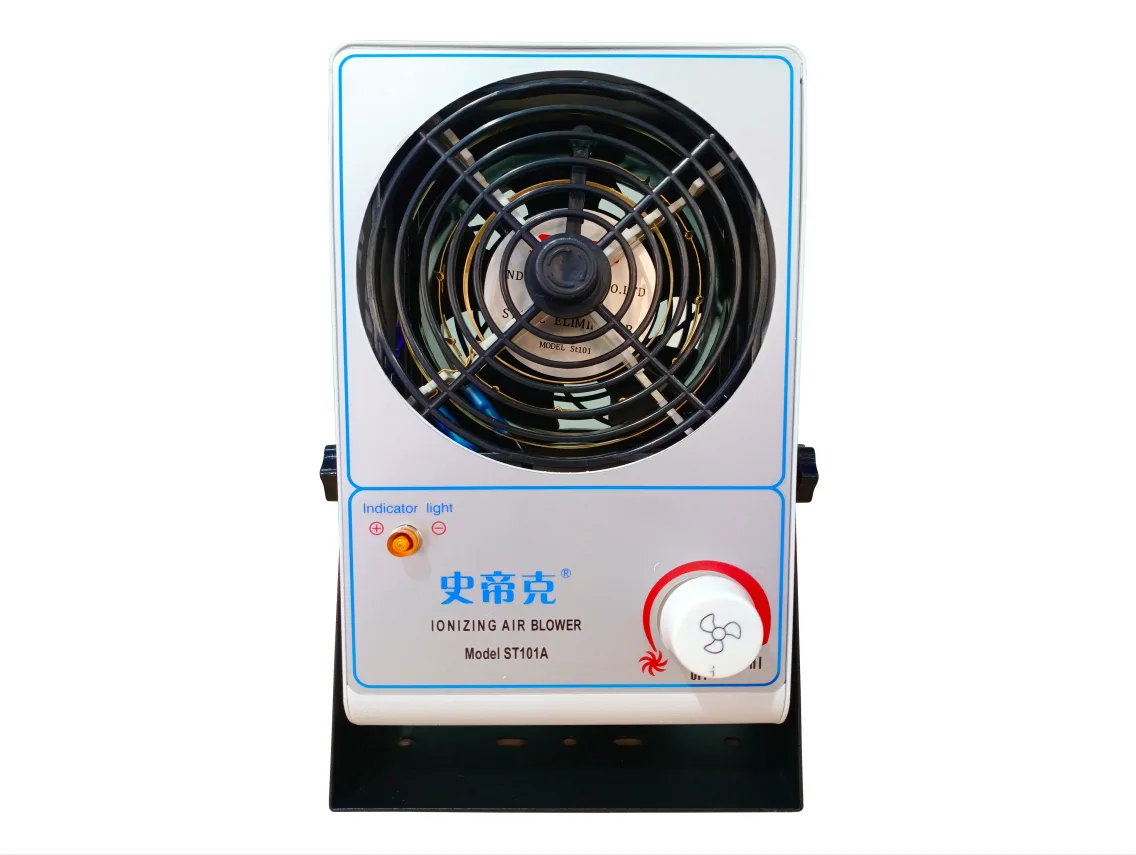


ST101A Desktop Ionizing Air Blower
A desktop blower for a single operator position — an inspection bench, a rework station, a microscope. At 90 × 170 × 260 mm and 3.3 kg it stands beside the work rather than over it, and airflow adjusts from 45 to 110 CFM so it can be turned down to something an operator will leave switched on.
- Air coverage
- 40 × 60 cm
- Airflow
- 45–110 CFM, adjustable
- Ion balance
- 0 V ±10 V
- Size / weight
- 90 × 170 × 260 mm · 3.3 kg
- Supply
- 110 V/60 Hz or 220 V/50 Hz
Sized for one position. For a two-operator bench see the ST104A; for a full line, the ST1200.
What the ST101A Fixes
If any of these is happening at your workstation, the cause is usually a surface charge nobody is measuring.
-
Operators get shocks at the bench
Charge builds on the parts and the packaging and discharges through whoever handles them. A blower over the position neutralizes the area rather than one object.
-
Dust settles back onto parts you just cleaned
A charged surface pulls particles out of the air within seconds. Neutralize the bench and cleaning holds.
-
The bench blower is too big for the bench
At 90 × 170 × 260 mm and 3.3 kg this sits beside a microscope or a rework station without taking the working area.
How It Works
Positive and negative ions are produced by corona discharge at the emitter points and carried to the work by the fan. Airflow is adjustable from 45 to 110 CFM: more air reaches further and neutralizes faster, less air is quieter and disturbs light parts less. Ion balance is held at 0 V ±10 V. The ST101A works on the alternating-current principle, and the high-voltage generator is built into the housing rather than supplied as a separate box.
The process is self-limiting: once a surface reaches neutral it stops taking up ions. What decides whether it works in practice is whether the airflow actually reaches the charged surface — which is why coverage area, not ion output, is the figure to size a blower on. Verify the result with a static field meter rather than assuming it.
Specifications
| Model | ST101A |
| Operating voltage | 110 V / 60 Hz or 220 V / 50 Hz |
| Power | 7.5 W to 25 W |
| Current consumption | 0.25 A or 0.12 A |
| Ion emission | Alternating current (AC) |
| High-voltage generator | Built in |
| Air volume | 45–110 CFM, adjustable |
| Air coverage | 40 cm × 60 cm |
| Ion balance | 0 V ±10 V |
| Operating temperature | −10 °C to 50 °C |
| Dimensions | 90 mm (L) × 170 mm (W) × 260 mm (H) |
| Weight | 3.3 kg |
Decay Time — Measured
Measured decay times, taken directly in front of the unit. Decay slows with distance: at 300 mm the ST101A clears 1 kV in about 1.2 seconds, at 900 mm it takes around 4 seconds. Mount it as close to the charged work as the operator can tolerate.
| 300 mm | 600 mm | 900 mm | |
|---|---|---|---|
| Positive decay | 1.2 s | 2.5 s | 3.9 s |
| Negative decay | 1.3 s | 2.6 s | 4.1 s |
| Offset voltage (+) | 8 V | 5 V | 4 V |
| Offset voltage (−) | −7 V | −6 V | −3 V |
Charge decay measured from 1 kV to 100 V, unit running on 110/220 V, ambient 22 °C and 75 %RH.
Offset voltage is the residual charge the blower itself leaves behind. At 300 mm it stays within 8 V, and it falls further with distance — well inside the 0 V ±10 V balance figure quoted above.
Not sure the ST101A is the right size? Send the area you need to cover, what the material is and the measured surface voltage — we will come back with a model and a mounting position.
Where It Goes
A blower neutralizes an area rather than a line. These are the positions the ST101A is sized for.
One operator position
An inspection bench, a rework station or a microscope position — the blower covers the working area in front of the operator.
Electronics and SMT benches
Where components are handled outside their packaging and electrostatic discharge damages parts without leaving a mark.
Packaging and labelling
Where charged film and labels cling, misfeed or attract dust at a manual station.
Bar or Blower, and Which Blower
Use an ionizing bar when the material moves past a fixed point — off a roller, out of a tool, off a stack. A bar mounted at that point neutralizes faster and holds a tighter balance, and is cut to the exact width of the material. Use a blower when the charge sits on a fixed area, or when there is no way to mount a bar within its 1 m working range.
Between the blowers it is a question of area: ST-S200 450 × 450 mm to build into a machine, ST101A 40 × 60 cm for one position, ST104A 60 × 120 cm for a wider bench, and ST1200 140 × 120 cm across a full line.
Frequently Asked Questions
What area does the ST101A cover?
40 × 60 cm. That is a coverage area in front of the unit, not a working distance — it is sized for one operator position rather than a line.
How much airflow does it deliver?
45 to 110 CFM, adjustable. Turn it up for faster neutralization, down for quieter running and less disturbance to light parts.
What ion balance does it hold?
0 V ±10 V.
Will it fit on a working bench?
It is 90 × 170 × 260 mm and 3.3 kg, so it stands beside a microscope or a rework station without taking the working area.
What power supply does it need?
110 V / 60 Hz or 220 V / 50 Hz, drawing 0.25 A or 0.12 A respectively.
Should I use a blower or a bar?
A bar neutralizes material moving past it on a line. A blower carries ionized air to a fixed area. If the material moves, choose a bar; if the charge sits still at a bench, choose a blower.
ST101A, ST104A or ST1200?
The ST101A covers 40 × 60 cm for one position, the ST104A 60 × 120 cm for a wider bench or two operators, and the ST1200 140 × 120 cm across a full line.
How fast does the ST101A neutralize?
From 1 kV down to 100 V it takes about 1.2 seconds at 300 mm, 2.5 seconds at 600 mm and 3.9 seconds at 900 mm, tested at 22 °C and 75 %RH. Residual offset voltage stays within 8 V positive and −7 V negative across that range.
Request a quote for the ST101A Give us the area to cover, the material and the measured surface voltage.
Related Products


New to ionization? What is an ionizing bar covers how corona discharge neutralizes a charged surface, and ionizing bar voltage output explains the kV figure. To compare the whole range, see all industrial static eliminators and ionizing bars.