
Filter Efficiency vs Bypass Leakage in a Cleaning System
A dry-cleaning proposal may mention a high-efficiency filter for its extraction system. Before comparing machines, identify what the claim covers: the filter element, the installed assembly, or the result on the material. Follow the particle path and match each report to the question it actually answers.
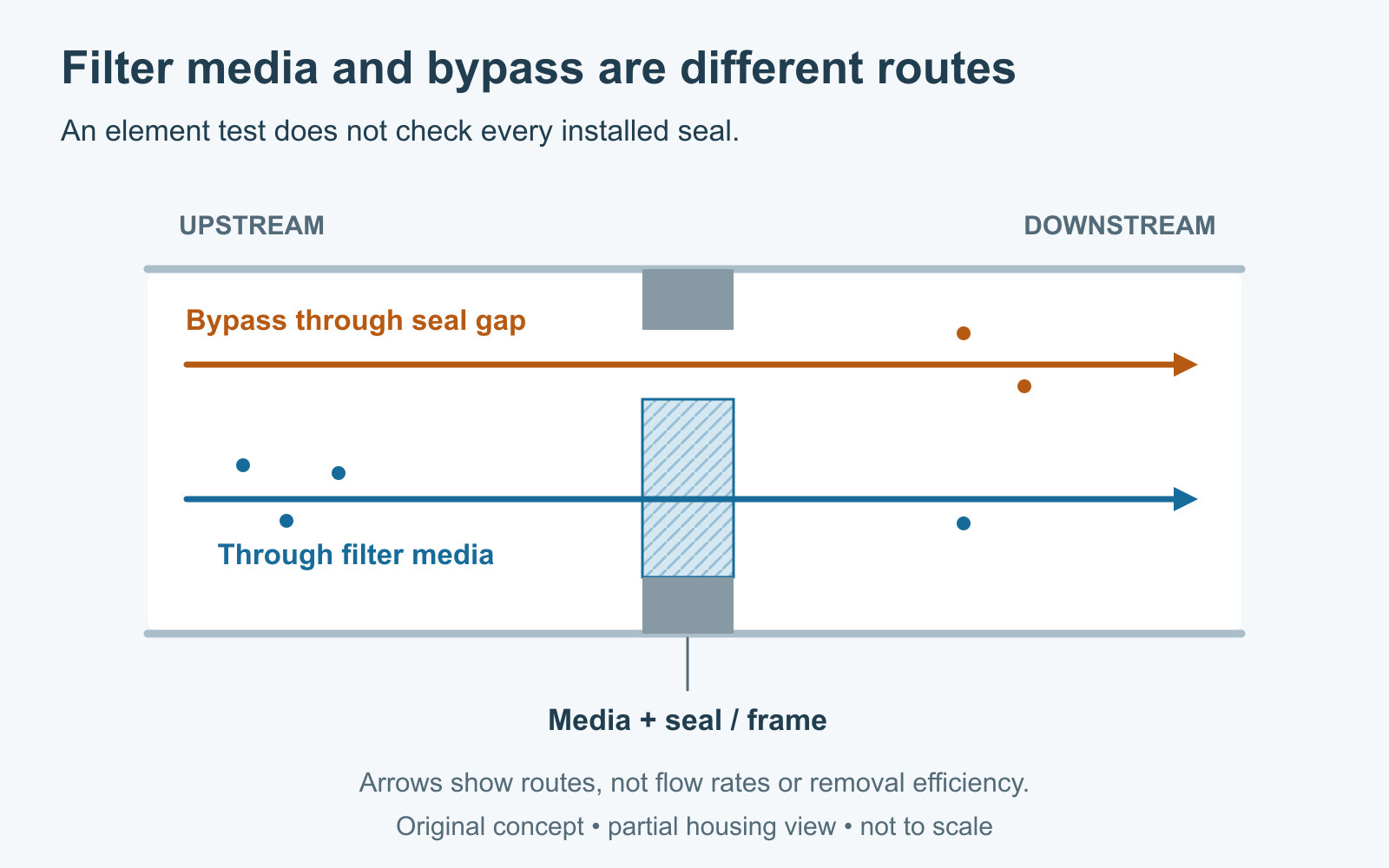
Original concept diagram, not to scale. It shows possible internal flow paths, not a DGSDK machine drawing or measured filtration performance.
Follow both paths at the filter
Air crossing a seal gap bypasses the filter medium. Increasing media efficiency does not seal that gap. The illustration separates these paths without assigning an efficiency or leakage rate.
Read the filter report as an element report
If a proposal specifies HEPA or another classification, request the named standard, class, filter identification and relevant report. ISO 29463-1:2024 describes performance-based classification, assessment, marking and documentation of test results. Its companion ISO 29463-4:2011 covers leakage testing of filter elements.
Check the test conditions and the object that was tested. Evidence about an element is useful, but it does not automatically describe its eventual installation. A percentage copied into a quotation without the report cannot tell you which mounting arrangement, operating condition or particle test basis it represents.
Identify the installed test boundary
The DOE 2022 air-cleaning handbook, sections 4.1.5.3 and 4.1.9.10, distinguishes installed testing of seals, housings and bypass routes from component performance. Its subject is nuclear facilities; its acceptance limits are not general requirements for surface-cleaning equipment.
For a proposed installation, ask the responsible engineer which assembly and potential bypass paths the report includes. Retain its method, operating condition, criterion and date. Agree what verification is appropriate after a filter replacement or disturbance. The phrase “leak tested” needs that context.
Keep collection and the cleaned surface separate
HSE's local-exhaust-ventilation guidance identifies the hood, ducting, air-cleaning device and fan as distinct parts of a connected system. It asks for documentation of the actual layout and operating information. Its purpose is exposure control, not certification of a cleaned film or board.
For a surface-cleaning review, this leads to a separate question: what reaches the collection head, and what remains on the material? Filtration evidence alone does not answer either. Keep the installed collection conditions and material trial in separate records, with the material, contamination and surface acceptance method identified.
Use our installed airflow and pressure article for the flow question, and the surface-particle inspection report guide for the material result. The web-cleaning guide covers the broader process choices.
Keep four records together
| Record | Question to resolve | Your reference |
|---|---|---|
| Filter element | Which filter, classification and test report? | ___ |
| Installed assembly | Which seals and bypass paths were included, under what condition? | ___ |
| Collection at the head | Which installed setup and operating condition were checked? | ___ |
| Material trial | Which material, contamination and surface acceptance method? | ___ |
This is a proposal-review aid, not a certification form. Leave unsupported fields open and request the missing evidence. A result for one component should remain attached to that component until the wider claim has its own support.
Define the cleaning result you need
Share the material, contaminant, line layout and required surface result with Shidike. Include any specified extraction or filtration requirement so the proposed configuration and its supporting documents can be reviewed together.
Explore Cleaning Machines →Discuss your cleaning application →