

ST-S200 Mini Ionizing Air Blower
The smallest unit in the range — 128 × 53.5 × 180 mm and 400 g, small enough to build into a machine rather than stand beside one. Synchronous positive and negative emitters at ±5000 V with tungsten-alloy tips. Coverage area 450 × 450 mm; decay is rated ≤1.5 s measured 150 mm in front of the outlet — one point, not the whole area. Under 38.9 dB and 0.05 ppm ozone. CE marked, one-year warranty.
- Coverage area
- 450 × 450 mm
- Decay time
- ≤1.5 s at 150 mm from the outlet
- Airflow / noise
- ≤48.2 CFM · ≤38.9 dB at 1 m
- Size / weight
- 128 × 53.5 × 180 mm · 400 g
- Certification
- CE · one-year warranty
Small enough to build into a machine rather than stand beside one. Ozone stays at or below 0.05 ppm.
What the ST-S200 Fixes
If any of these is happening on your line, the cause is usually a surface charge nobody is measuring.
Charge on parts that are not moving
A bar neutralizes material passing in front of it. When the charge is on a stationary part, a stack, or an operator's hands, nothing passes the bar.
Ionized air carried to the areaNo room for a bench blower
Inside a machine enclosure, on a frame, or under a shelf there is often no space for a full-size unit.
400 g, 180 mm tall, U-bracket includedThe blower is loud enough that operators switch it off
A unit that gets turned off protects nothing. Noise is a real reliability factor at a manned station.
≤38.9 dB measured 1 m awayHow It Works
Synchronous positive and negative emitter electrodes at ±5000 V produce a corona discharge at tungsten-alloy tips; an axial fan carries the ions to the surface.
It is the smallest device Shidike makes. At 128 × 53.5 × 180 mm and 400 g it is designed to be mounted inside equipment as much as placed on a bench — the case is flame-retardant plastic and it ships with a stainless U-bracket and a pair of plastic thumb screws.
The discharge structure is a decoupled barrel type, so there is no direct electrical contact at the emitter. Fan speed is adjustable across three settings, which is the practical control you have over the trade between decay time, airflow and noise.
Where a bar neutralizes a line of material passing in front of it, the ST-S200 covers an area: 450 × 450 mm. The ≤1.5 s decay is a separate figure, rated at one point 150 mm in front of the outlet. The coverage area is published without a distance or an acceptance condition, so it is not a promise that the whole square clears in that time — establish what you need across your own working area.
- Compact body, straightforward to mount — including inside equipment where a bench unit will not fit
- Low power draw: 12 W fan plus 5 W ion generator
- Three-speed fan — high, medium, low
- Front and rear grilles are removable for cleaning and maintenance
- Tungsten-alloy emitters in a decoupled discharge barrel — no direct electrical contact to erode
- Supplied with a dedicated adapter: AC 100–240 V in, DC 24 V 1500 mA out
Specifications
| Model | ST-S200 |
| Input voltage | DC 24 V |
| Power | Fan 12 W, ion generator 5 W |
| Working voltage | ±5000 V |
| Ion emission | Pulsed DC |
| Emitter electrode | Tungsten alloy |
| Discharge structure | Decoupled electrical contact, discharge barrel |
| Coverage area | 450 × 450 mm (L × W) |
| Decay time | ≤1.5 s, measured 150 mm in front of the outlet |
| Ion balance | Not published as a voltage — the product data gives a distance and a time in this field. Ask for the offset if your process sets a limit. |
| Airflow | ≤48.2 CFM |
| Noise | ≤38.9 dB, measured 1 m from the outlet |
| Ozone concentration | ≤0.05 ppm, measured 150 mm from the outlet |
| Fan speed | Three settings — high, medium, low |
| Status indication | LED, lit in normal operation |
| Operating temperature | 0–50 °C |
| Operating humidity | 30–70 % RH |
| Dimensions | 128 × 53.5 × 180 mm (L × W × H) |
| Housing | Flame-retardant plastic |
| Mounting hardware | One stainless U-bracket, one pair of M5 × 10 plastic thumb screws |
| Power adapter | Input AC 100–240 V 50/60 Hz, output DC 24 V 1500 mA |
| Net / gross weight | 400 g / 700 g |
| Warranty | 1 year |
| Certification | CE |
Not sure the ST-S200 is the right bar? Send the material, line speed, working distance and measured surface voltage — we will come back with a model, a length and a mounting position.
Where It Goes
The ST-S200 neutralizes an area rather than a line, sized for one operator position or the inside of a machine.
One operator position
An assembly bench, an inspection station or a repair desk. The 450 × 450 mm coverage is sized for the working area in front of one person, not a whole line.
Built inside equipment
At 400 g and 180 mm tall it mounts inside a machine enclosure, on the frame, or under a shelf where a bench blower will not fit. This is the case the size is designed for.
Where a bar cannot reach
When the charge is on a stationary part, a stack, or an operator's hands, moving ionized air onto it is what works — and that is a blower, not a bar.
Bar or Blower, and Which Blower
A bar sits across a line and neutralizes material moving past it; a blower carries ionized air to a fixed area. If the material moves, use a bar. If the charge sits still — parts on a bench, a stack, an operator's hands — use a blower.
| ST-S200 | 450 × 450 mm, ≤48.2 CFM, 400 g. The smallest — built into equipment, or one operator position. |
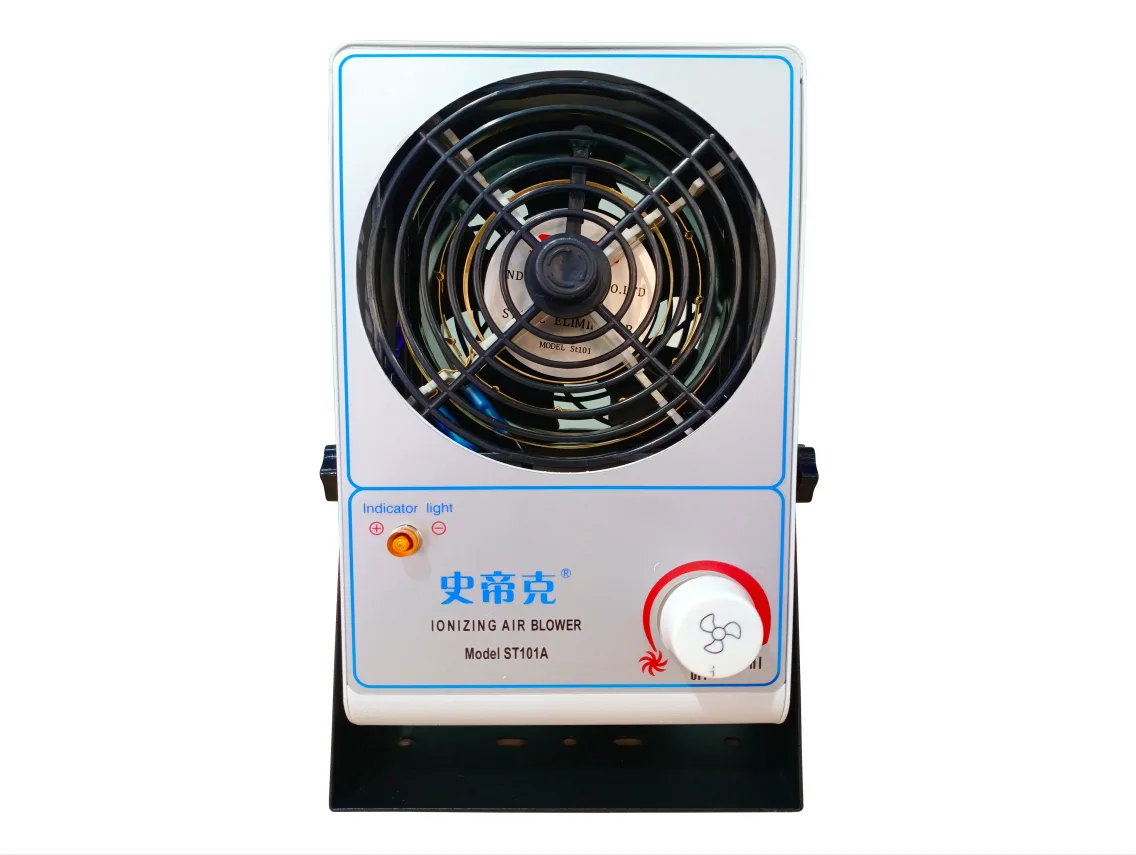
| ST101A | Desktop unit for a single workstation or inspection table. |
| ST104A | Horizontal airflow across a wider zone — a two-operator bench or a packing station. |
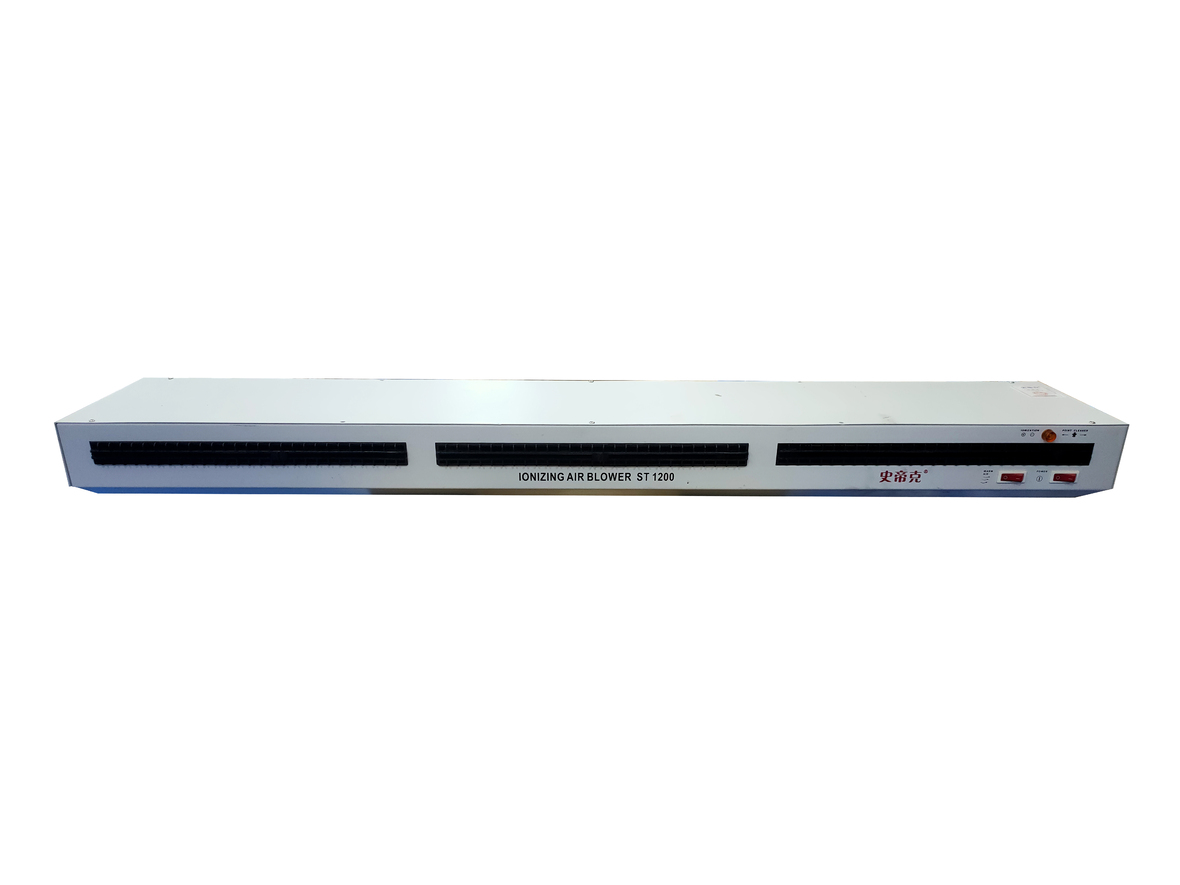
| ST1200 | The widest coverage in the range, spanning a full line rather than one station. |
Frequently Asked Questions
What area does the ST-S200 cover?
450 × 450 mm. That is a coverage area, not a working distance — the unit neutralizes a square of roughly that size in front of it, sized for one operator position or the inside of a machine.
How quickly does it neutralize?
Decay time is 1.5 seconds or less, measured 150 mm in front of the outlet. Further from the outlet it takes longer; the three fan speeds let you trade decay time against airflow and noise.
How loud is it?
38.9 dB or less, measured 1 m from the outlet. That matters more than it sounds: an operator sitting beside a loud blower all shift will switch it off, and a blower that is off protects nothing.
Can the ST-S200 be built into a machine?
Yes — that is what the size is for. It is 128 × 53.5 × 180 mm and 400 g, with a flame-retardant plastic housing, and ships with a stainless U-bracket and a pair of M5 × 10 plastic thumb screws.
What powers it?
A DC 24 V supply. A dedicated adapter is supplied: AC 100–240 V 50/60 Hz in, DC 24 V 1500 mA out. The fan draws 12 W and the ion generator 5 W.
How much ozone does it produce?
0.05 ppm or less, measured 150 mm from the outlet.
Should I use a blower or a bar?
A bar neutralizes material moving past it on a line. A blower carries ionized air to a fixed area. If the material moves, choose a bar; if the charge sits still, choose a blower.
Is the ST-S200 certified, and what warranty does it carry?
It is CE marked and carries a one-year warranty.
Request a quote for the ST-S200 Give us the material, line speed, working distance and measured surface voltage, and the length you need.



New to ionization? What is an ionizing bar covers how corona discharge neutralizes a charged surface, and ionizing bar voltage output explains the kV figure. To compare the whole range, see all industrial static eliminators and ionizing bars.