

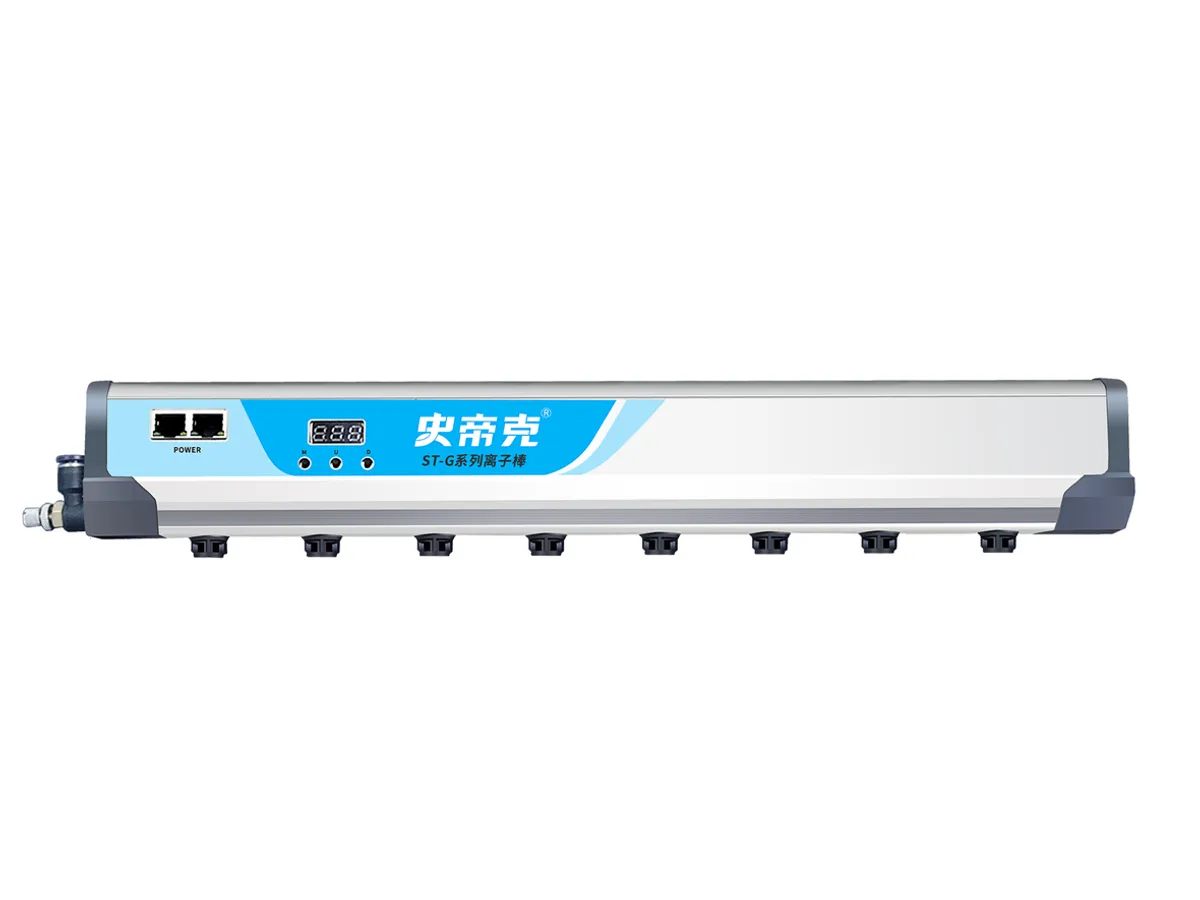
ST-F Intelligent Ionizing Bar
The speed model. Pulsed DC with the Hibweer L.C.C. system, which stops generating negative ions while it makes positive ones and vice versa — rated at 2.5 times the neutralizing speed of a conventional bar. Choose it when the material moves too fast for a standard bar to keep up. Ion balance ±100 V, 6.5 kV DC pulse from DC 24 V, 12 W.
- Neutralizing speed
- 2.5× a conventional bar, rated
- Ion balance
- ±100 V — the trade for the speed
- Control
- Hibweer L.C.C. · pulse width varies with frequency
- Working distance
- 30–1000 mm
- Output
- 6.5 kV DC pulse · pulsed DC · DC 24 V, 12 W
The model for lines that move faster than a standard ionizer can follow. Speed is the specification; balance is what you trade for it.
What the ST-F Fixes
If any of these is happening on your line, the cause is usually a surface charge nobody is measuring.
Charge clears at low speed but not at full rate
The symptom is intermittent — the line runs clean during setup and starts producing rejects once it is up to speed.
Rated 2.5× a conventional barMaterial is only in front of the bar for a fraction of a second
On fast indexing or pick-and-place, decay time is the binding constraint, not ion balance.
Pulsed DC with phase separationA bar that worked before a line upgrade stopped working after it
Nothing failed — the line simply got faster than the ionizer. The bar is doing exactly what it always did.
Swap to the ST-F, same mounting and 24 V supplyHow It Works
Pulsed DC with the Hibweer L.C.C. system: while the bar generates positive ions it stops generating negative ones, and vice versa.

Separating the two phases in time rather than overlapping them is what produces the speed, rated at 2.5 times that of a conventional bar. The rating is published without a comparison model or test conditions, so read it as the manufacturer's figure for the method rather than as a result on your line. Where a standard bar needs the material to dwell in front of it, the ST-F is built to clear the charge in the time the material is actually there.
The Hibweer L.C.C. system also adjusts pulse width according to frequency, so ion generation is matched to the line rather than run flat out.
Ion balance is ±100 V — the loosest of the three bar series, and the trade you make for the speed. If speed is not your constraint, the ST-G at ±50 V is the better default.
- Supersonic air-intake structure, which is what the bar's neutralizing speed is attributed to
- Up to 100 Hz pulse rate for high-speed moving targets
- Hibweer L.C.C. system adjusts pulse width with frequency for flexible control of ion generation
- Detects abnormal discharge, raises an alarm and cuts the high voltage automatically
- Broadband network port for line-level monitoring and industrial networking
- High voltage generated inside the bar — no external power supply box, no fixed HV cable
Specifications & Dimensions
| Model | ST-F series intelligent ionizing bar |
| Input voltage | DC 24 V |
| Power | 12 W |
| Ion generation | Corona discharge |
| Output | 6.5 kV DC pulse (pulsed DC, Hibweer L.C.C.) |
| Ion balance | ±100 V |
| Static decay time | 1 s, rated — initial surface voltage, working distance and measurement method not published |
| Working distance | 30–1000 mm |
| Operating temperature | 0–45 °C, no condensation |
| Operating humidity | 15–75 % RH, no condensation |
| Cross-section | 30 × 82 mm |
| Length | Made to order from 300 mm, up to 3 m |
| Protection | Abnormal-discharge alarm with automatic high-voltage cutoff |
| Connectivity | Broadband network port |

Mounting hole pitch by bar length
Every bar takes two mounting holes, and the pitch is always the bar length less 120 mm — so you can work out the drilling for any made-to-order length.
| Bar length (L) | Mounting hole pitch (P) | Holes |
|---|---|---|
| 300 mm | 180 mm | 2 |
| 600 mm | 480 mm | 2 |
| 900 mm | 780 mm | 2 |
| 1200 mm | 1080 mm | 2 |
| 1500 mm | 1380 mm | 2 |
| 1800 mm | 1680 mm | 2 |
| 2100 mm | 1980 mm | 2 |
| 2400 mm | 2280 mm | 2 |
| 2700 mm | 2580 mm | 2 |
Not sure the ST-F is the right bar? Send the material, line speed, working distance and measured surface voltage — we will come back with a model, a length and a mounting position.
Where It Goes
The bar mounts across the material, facing it, anywhere from 30 mm to 1 m away. Choosing the ST-F for its speed does not cost you mounting flexibility.
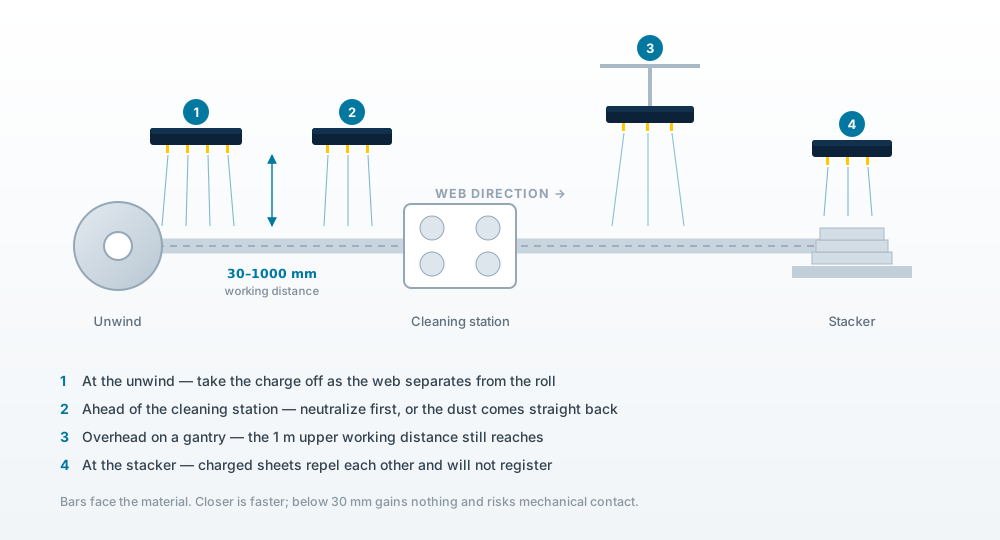
High-speed web and converting lines
When line speed rises past what a standard bar can neutralize, the symptom is intermittent — charge cleared at low speed, not at full rate. The ST-F is the model for that.
Fast indexing and pick-and-place
Where material is only in front of the bar for a fraction of a second, decay time is the binding constraint, not ion balance.
Retrofitting a line that got faster
A bar that worked before a line upgrade often stops working after it. Swapping to the ST-F addresses the speed without changing the mounting or the 24 V supply.
Which Model, and What Length
All three bar series are rated 6.5 kV pulse output, generated inside the bar from a DC 24 V supply at 12 W, over a 30–1000 mm working range, and all three are made to length. What differs is how that high voltage is applied — pulsed AC on the ST-G, pulsed DC on the ST-E and the ST-F — and that decides which one fits your line.
| ST-G — pulsed AC | Ion balance ±50 V, the tightest of the three. Adjustable frequency to 100 Hz. The default choice unless something below applies. |
| ST-E — high-frequency pulsed DC | Ion balance ±80 V. Fixed-polarity pins arranged alternately — each pin holds one polarity — which is why this is the bar positioned for a wide or long span, where a single-emitter design drifts. |
| ST-F — pulsed DC, Hibweer L.C.C. | Ion balance ±100 V, with neutralizing speed rated 2.5× a conventional bar; the ST-G and ST-E carry a 2× rating. Neither figure is published with a comparison model or test conditions, so the two ratings cannot be read as measured against one reference. Choose it when the material moves too fast for a standard bar to keep up. |
Made to your width
Bars are not sold in fixed sizes. We cut the bar to the width of your material, anywhere from 300 mm to 3 m, so you are not paying for length you do not use or leaving an edge uncovered.
Frequently Asked Questions
How much faster is the ST-F?
Rated at 2.5 times a conventional bar, against the ST-G and ST-E at 2×. The rating is attributed to the Hibweer L.C.C. system, which stops negative ion generation while producing positive ions and vice versa rather than overlapping the two phases. Neither figure is published with a comparison model or test conditions, so it is a nominal multiple, not a guaranteed decay time on your material.
What ion balance does the ST-F achieve?
±100 V. That is the loosest of the three Shidike bar series — the ST-G is ±50 V and the ST-E is ±80 V — and it is the trade you make for the speed.
When should I choose the ST-F over the ST-G?
When the material moves too fast for a standard bar to neutralize in the time it is in front of the bar. If speed is not your constraint, the ST-G has tighter balance and is the better default.
What is the Hibweer L.C.C. system?
A control system that separates the two ion polarities in time — generating one while suppressing the other — and adjusts pulse width according to frequency. Separating the phases is what the 2.5× rating is attributed to; varying the pulse width matches output to line speed.
What is the ST-F's working distance?
30 mm to 1000 mm, the same as the ST-G and ST-E.
Does the ST-F need a separate high-voltage power supply?
No. High voltage is generated inside the bar from a DC 24 V supply at 12 W — no external power supply box, no fixed-length high-voltage cable.
How long can an ST-F bar be?
Made to order from 300 mm up to 3 m, cut to the width of your material. The cross-section is 30 × 82 mm.
Request a quote for the ST-F Give us the material, line speed, working distance and measured surface voltage, and the length you need.



New to ionization? What is an ionizing bar covers how corona discharge neutralizes a charged surface, and ionizing bar voltage output explains the 6.5 kV figure. To compare the range, see all industrial static eliminators and ionizing bars.