
Dry Surface Cleaning Machines for PCB, FPC and Film
Professional industrial cleaning solutions for PCB, FPC, polarizer, backlight, optical film, SMT, LCM, and other precision manufacturing applications.
a surface:
Start Here: Adhesive Roller or Brush
Every machine we build is one of these two, configured to your material. There is no standard model to order from — width, belt, roller, gap and single or double sided are all set from your sample. If you are not sure which method your surface tolerates, what is web cleaning classifies them by what actually touches the material.

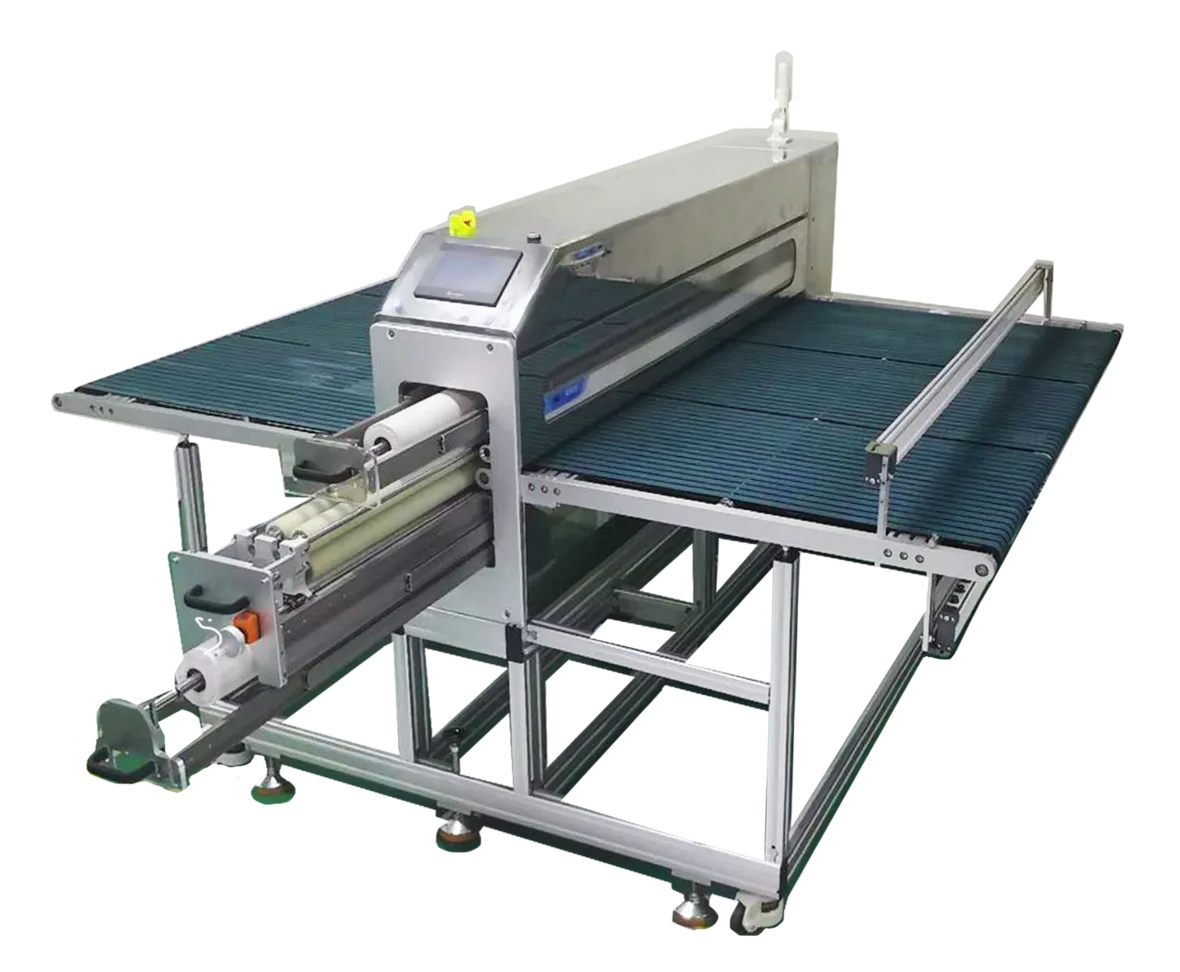
Contact Cleaning Machine
An elastomer roller lifts particles off the surface onto an adhesive paper roll. What most board, sheet and film work uses.
- 50–1340 mm, built to material
- 0.05–3 mm thickness
- Up to 70 m/min · 99.9 % rated removal
- 3 belt types · 3 roller materials

Brush and Vacuum Cleaning Machine
Fibre brushes free the particles and a 2200 m³/h vacuum carries them away. Nothing tacky touches the working face.
- 750 mm cleaning width
- Static held under 100 V
- 0–45 m/min · 99.9 % rated removal
- Separate Toray-cartridge collector
Configurations we have built — 12 machines
Built for Sheet & Board
Contact machines we have built for discrete boards and sheets. Each is the same process configured differently — belt, roller gap and roller tack set from the sample.

LCM
LCM Module Cleaner
- 0.022–0.34 mm
- Breakage <0.02 %
- 0–50 m/min
- Static <100 V
ST-DT1340
CCL Cleaning Machine
- 0.05–3 mm
- 99.9 % rated removal
- 0–70 m/min
- 350 W

SMT600
SMT Inline Cleaner
- Dual-sided rollers
- Integrated static elimination
- Quick-change window
- 220 V / 50 Hz

STXF
PCB Surface Cleaner
- 0.05–2 mm
- 99.9 % rated removal
- 0–20 m/min
- Static <50 V

STC-640
PCB Vertical Cleaner
- W620 × L510 mm max
- 0.1–2 mm
- ~6 s per board
- Static <50 V

STXT
FPC 4-Axis Cleaner
- 0.022–0.34 mm
- 4 tacky rollers
- 0–50 m/min
- Static <200 V

STXS
FPC 8-Axis Cleaner
- 0.028–2 mm
- 8 tacky rollers
- 0–35 m/min
- Static <200 V

ST-XT
Stamp Inspection Cleaner
- 0.05–0.65 mm
- 2 MP colour CCD
- 0–50 m/min
- Backlight 20 000 LUX
Polarizer Precision Cleaner
Model code to confirm
→View product
Backlight Panel Cleaner
Model code to confirm
→View productFilm Cleaning Configurations
Contact machines configured for film and thin sheet. What a given build handles — sheet fed, roll fed, or both — is set from your material, and the web path, tension control, controls, extraction and any unwind or rewind stands are confirmed in the quotation rather than assumed. Where a cleaning head sits in a line sets out what else a web line needs around it.


How a machine is configured
Every machine is built to the sample you send. Two choices do most of the work — what carries your material through, and what lifts the particles off it.
Transport belt
- Elastic belt — the standard, and what almost every machine ships with. We use Nitta and Forbo Siegling belts.
- Roller belt — specified occasionally.
- Round belt — specified occasionally.
Thickness, and whether the back face can take contact, usually decide it.
Cleaning roller
- Liquid silicone
- Solid silicone
- Rubber
Graded by tack. Too little and fine particles stay on the material; too much and the roller pulls at the surface. Matched to your sample, not to a datasheet.
Next: Static Eliminators & Ionizing Bars
What to send for a machine recommendation
There is no catalogue model that fits a line. Every machine is built to the sample you send us — the belt, the roller tack, the gap and the static package are all chosen from your material. Send these and we will specify all four:
- A sample of your material, and its thickness
- Working width, and whether length is fixed or continuous
- Line speed
- Conveyor height you need to match on the upstream and downstream equipment
- Whether the back face can take contact, or must stay unmarked
Common questions
How does contact cleaning actually work?
An elastomer roller runs against the surface and lifts loose particles off it. Those particles transfer onto an adhesive paper roll, which winds them away permanently rather than redistributing them. That is the difference from an air knife or a brush: both move contamination around, and a contact cleaner removes it from the line.
Which belt will my material need?
Three belt types are available. An elastic belt is the standard and is what almost every machine ships with — we use Nitta and Forbo Siegling belts. A roller belt and a round belt are also available, but they are specified only occasionally, for materials the standard belt does not suit. The belt is chosen from your sample: thickness, and whether the back face can take contact, are usually what decide it.
How is the cleaning roller chosen?
Three roller materials are available: liquid silicone, solid silicone and rubber. Which one you need is decided from your sample, and it is the most important choice on the machine. Too little tack and fine particles stay on your material; too much and the roller pulls at the surface, which on thin film or a soft coating causes its own defects. We match the material and the grade to the sample you send rather than picking one from a datasheet.
What are the consumables and how often do they change?
Two per machine: the elastomer cleaning roller, and the adhesive paper roll that takes particles off it. The paper is supplied as two rolls — one upper, one lower — with a 3.0 inch core, 20 m per roll, 800 D tack and knife-free changeover. Rollers and rolls pull out on a drawer mechanism, so a change does not mean dismantling the machine.
What material thickness and width can be cleaned?
Thickness from 0.022 mm up to 6 mm depending on configuration, effective width to 1500 mm, and length unrestricted on continuous material. The roller gap is adjustable from 0.1 to 6.0 mm with a one-touch mechanism and a digital readout, so one machine covers a range of thicknesses rather than a single one.
Do I need static control as well as cleaning?
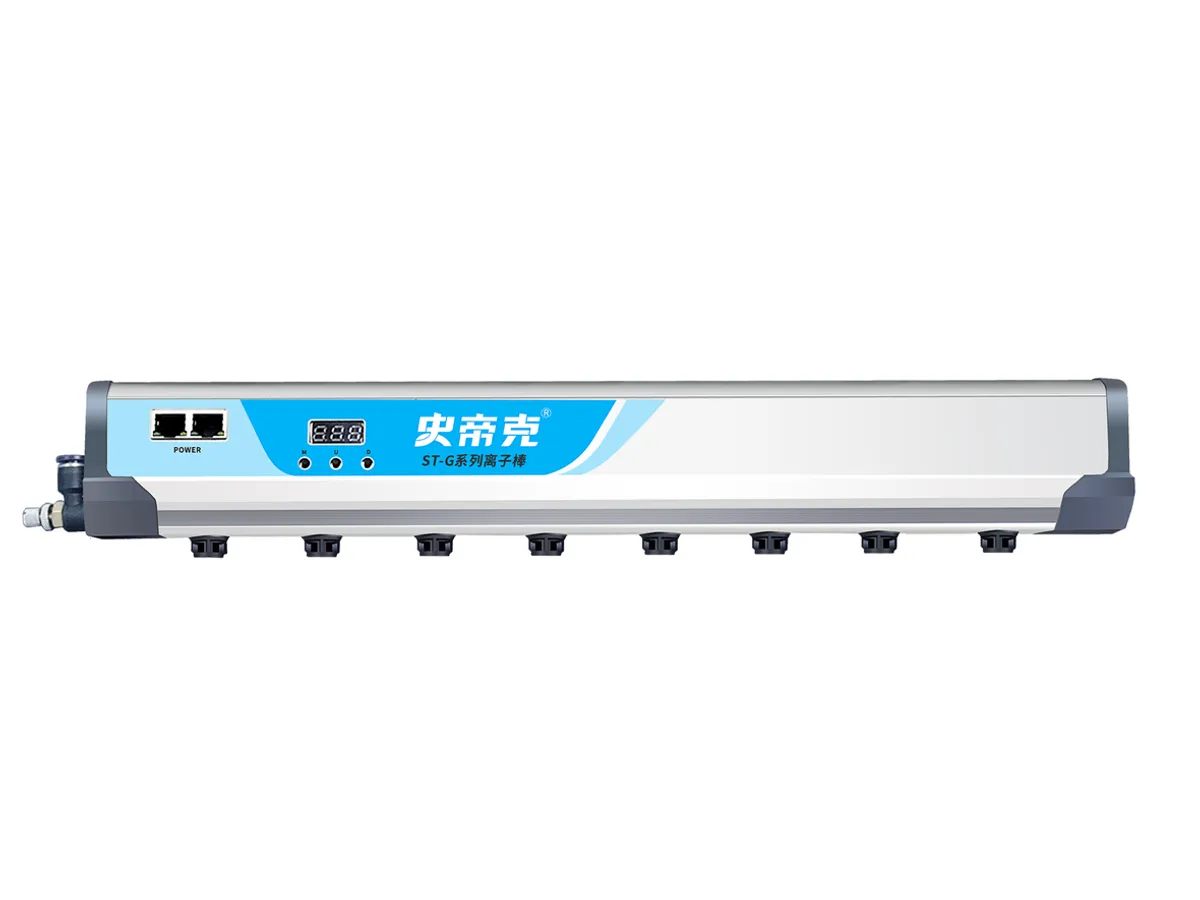
Yes, on almost every application. A charged surface pulls particles back out of the air within seconds of leaving the machine, so cleaning without neutralizing solves half the problem. The standard build is two ST-G ionizing bars made to the width of the machine. The ST-E is specified on wide machines where balance has to hold across the full span, and the ST-F where line speed is high. Some machines are also built with ST104A blowers mounted low on both sides.
What is the difference between an adhesive roller and a brush machine?
An elastomer roller runs against the surface and lifts the particle onto an adhesive collection roll — it takes off what is stuck, not just what is loose, and it is what most board and sheet applications use. A brush machine agitates the particle free instead and an extraction system carries it to a separate collector, so no tack is pressed onto the working face. Both touch the material: a brush cleaner is still a contact process, and a magnetic levitation transport does not change that either — it changes how the material is carried, not what meets the surface. Classify a machine by what touches the material during cleaning, and check the actual cleaning interface, including any optional brushes or supporting surfaces.