
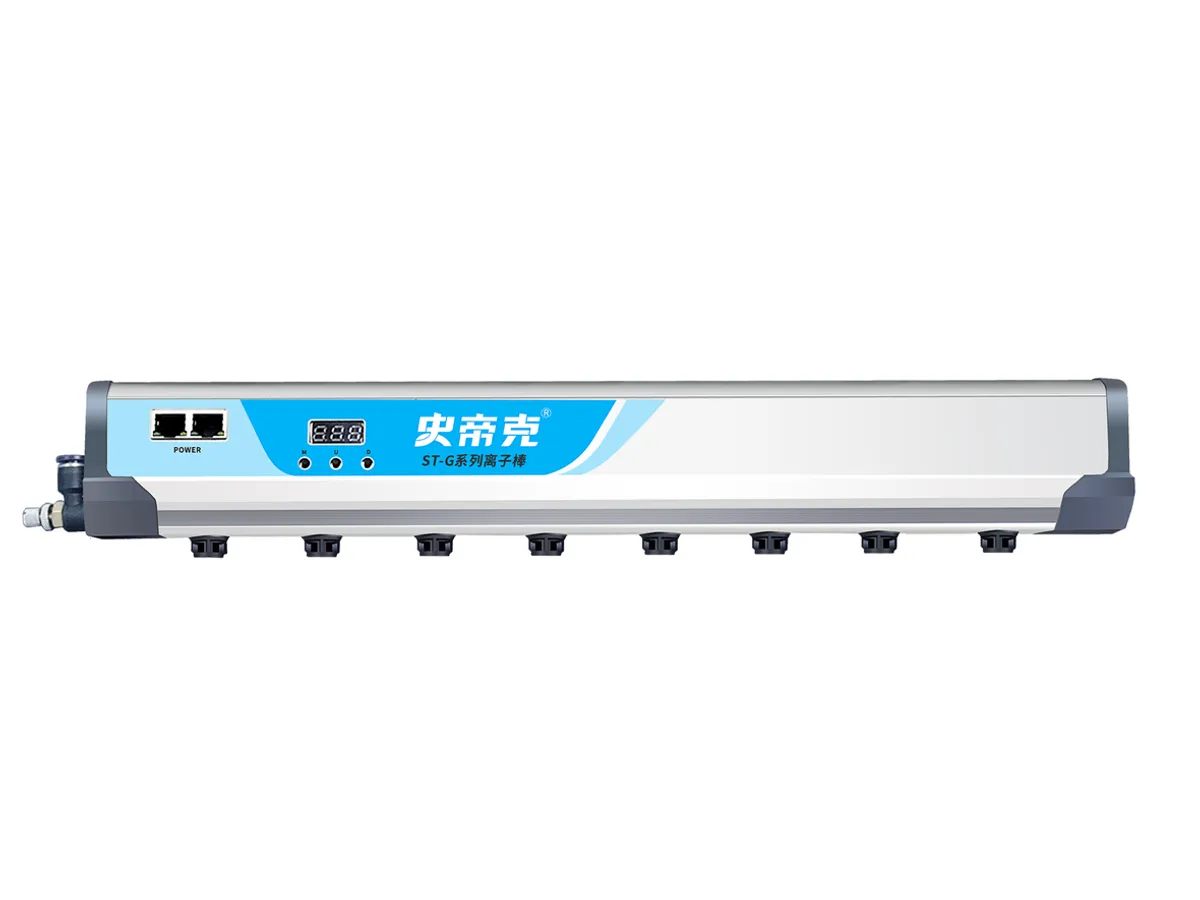

ST-G Intelligent Ionizing Bar
The all-round bar and the tightest ion balance in the Shidike range at ±50 V. Pulsed AC applies alternating positive and negative high voltage to a single emitter pin — more ions than conventional AC, without the uneven neutralization AC bars are known for. 6.5 kV pulse output, generated inside the bar from a DC 24 V supply at 12 W, over a 30–1000 mm working range.
- Ion balance
- ±50 V — tightest of the three bar series
- Working distance
- 30–1000 mm
- Output
- 6.5 kV pulse · pulsed AC · supply DC 24 V, 12 W
- Decay time
- 1 s rated · frequency adjustable to 100 Hz
- Length
- Made to order, 300 mm to 3 m
No external power supply box and no fixed high-voltage cable — the high voltage is generated inside the bar.
What the ST-G Fixes
If any of these is happening on your line, the cause is usually a surface charge nobody is measuring — and the fix is an ion bar mounted where the charge is made.
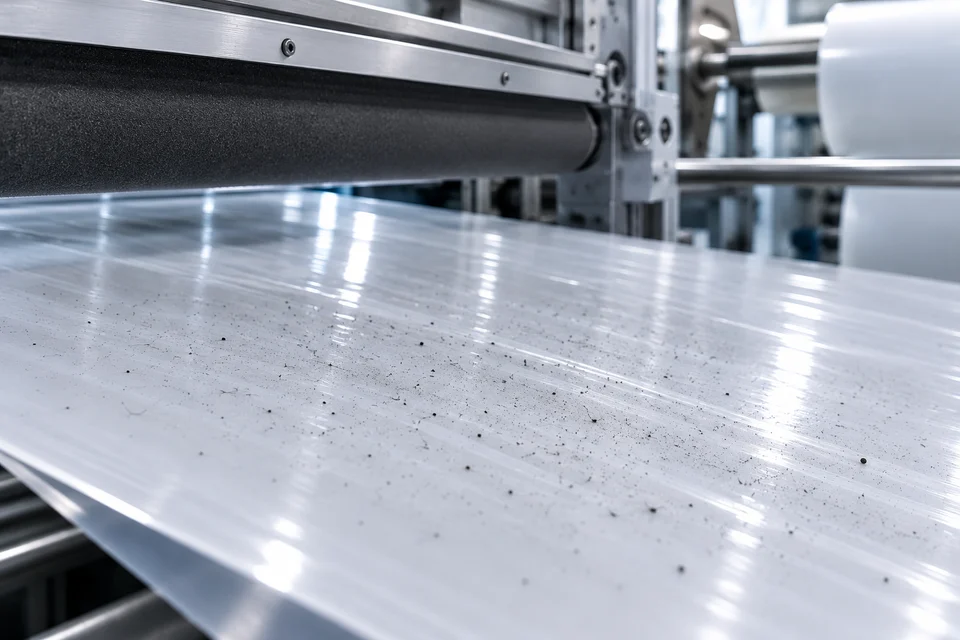
Dust comes back right after cleaning
A charged surface pulls particles out of the air again within seconds, so cleaning alone never holds.
Neutralize first — bar ahead of the cleaning station
Film and sheets cling, jam or misfeed
Charged material sticks to itself and to the machine: sheets double-feed, labels sit crooked, the web tracks off centre.
Bar at the unwind or infeed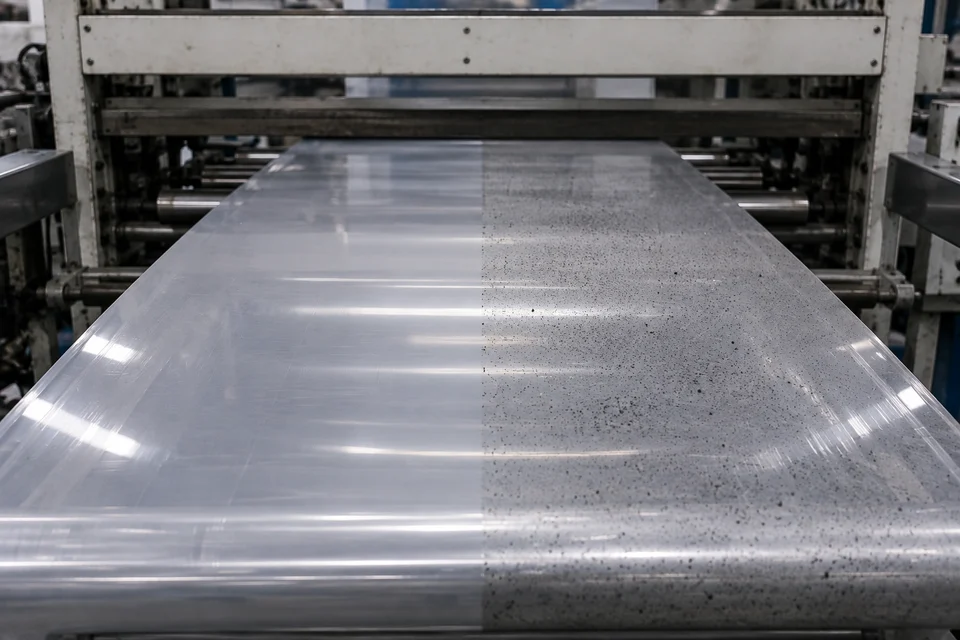
One end of the web is clean, the other is not
Conventional AC bars neutralize unevenly across a mains cycle, leaving alternating over- and under-charged patches.
Pulsed AC removes the unevennessHow It Works
Pulsed AC: a single emitter pin receives alternating positive and negative high voltage, so both ion polarities come from the same point.

Compared with a conventional AC bar this produces more ions and removes the uneven neutralization AC designs are prone to — one part of the web fully discharged while another is still charged.
The pulse frequency is adjustable up to 100 Hz. A high frequency suits material moving quickly past the bar; a low frequency lets the ion cloud travel further and hold down ambient static in the surrounding area. That range is why the ST-G suits a line where one bar has to do more than one job.
- Supersonic air-intake structure, which is what the bar's neutralizing speed is attributed to
- Up to 100 Hz pulse rate
- Detects abnormal discharge, raises an alarm and cuts the high voltage automatically
- Intelligent sensing system matches positive and negative ion output
- Broadband network port for line-level monitoring and industrial networking
- High voltage generated inside the bar — no external power supply box, no fixed HV cable
What is on the bar

Specifications & Dimensions
| Model | ST-G series intelligent ionizing bar |
| Input voltage | DC 24 V |
| Power | 12 W |
| Ion generation | Corona discharge |
| Output | 6.5 kV pulse, pulsed AC method — alternating positive and negative on a single emitter pin |
| Ion balance | ±50 V |
| Static decay time | 1 s, rated — initial surface voltage, working distance and measurement method not published |
| Working distance | 30–1000 mm |
| Operating temperature | 0–45 °C, no condensation |
| Operating humidity | 15–75 % RH, no condensation |
| Cross-section | 30 × 82 mm |
| Length | Made to order from 300 mm, up to 3 m |
| Protection | Abnormal-discharge alarm with automatic high-voltage cutoff |
| Connectivity | Broadband network port |

Mounting hole pitch by bar length
Every bar takes two mounting holes, and the pitch is always the bar length less 120 mm — so you can work out the drilling for any made-to-order length, not just the ones listed.
| Bar length (L) | Mounting hole pitch (P) | Holes |
|---|---|---|
| 300 mm | 180 mm | 2 |
| 600 mm | 480 mm | 2 |
| 900 mm | 780 mm | 2 |
| 1200 mm | 1080 mm | 2 |
| 1500 mm | 1380 mm | 2 |
| 1800 mm | 1680 mm | 2 |
| 2100 mm | 1980 mm | 2 |
| 2400 mm | 2280 mm | 2 |
| 2700 mm | 2580 mm | 2 |
All dimensions in millimetres. Leave clearance around the bar for maintenance — the emitter pins need to be reachable for cleaning.
Not sure this is the right bar? Send the material, line speed, working distance and measured surface voltage — we will come back with a model, a length and a mounting position.
Where It Goes
The bar mounts across the material, facing it, anywhere from 30 mm to 1 m away. These are the positions it is most often installed in.
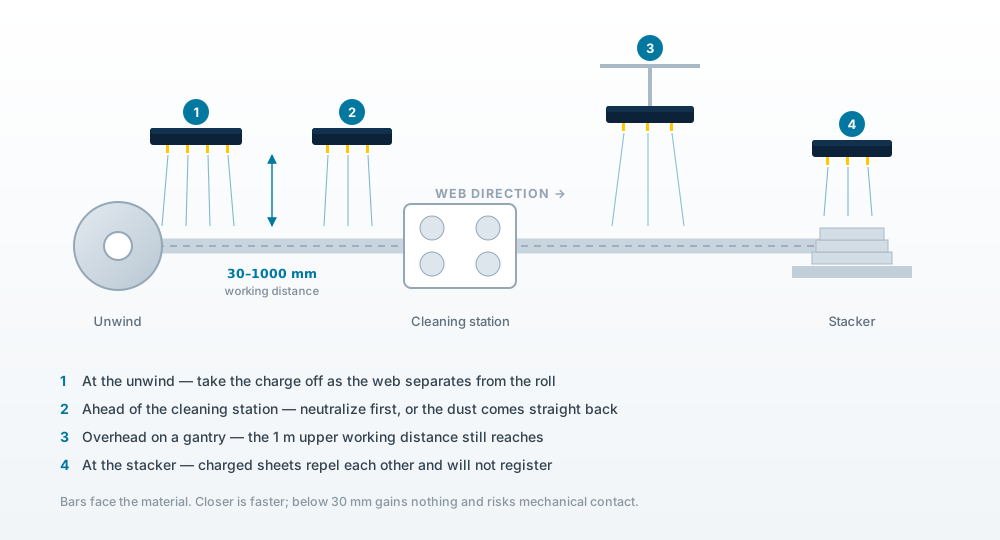
Ahead of the cleaning station
Charged film pulls particles back onto a surface seconds after it is cleaned. Neutralizing first is what makes the cleaning hold. The ST-G holds its own ion balance to ±50 V. That is the bar's offset, not the voltage left on your material — the residual your process can tolerate is a separate figure, measured on your own parts and set by your own spec.
At the unwind or infeed
Charge builds as material separates from the roll. Taking it off at the infeed stops the problems downstream rather than treating them one station at a time.
Overhead, on a gantry
Where the mounting point is a rail rather than a position beside the material, the 1 m upper working distance means a single bar still reaches. Closer than 30 mm gains nothing and risks mechanical contact.
Which Model, and What Length
All three bar series are rated 6.5 kV pulse output, generated inside the bar from a DC 24 V supply at 12 W, over a 30–1000 mm working range, and all three are made to length. What differs is how that high voltage is applied — pulsed AC on the ST-G, pulsed DC on the ST-E and the ST-F — and that decides which one fits your line.
| ST-G — pulsed AC | Ion balance ±50 V, the tightest of the three. Adjustable frequency to 100 Hz. The default choice unless something below applies. |
| ST-E — high-frequency pulsed DC | Ion balance ±80 V. Fixed-polarity pins arranged alternately — each pin holds one polarity — which is why this is the bar positioned for a wide or long span, where a single-emitter design drifts. |
| ST-F — pulsed DC, Hibweer L.C.C. | Ion balance ±100 V, with neutralizing speed rated 2.5× a conventional bar; the ST-G and ST-E carry a 2× rating. Neither figure is published with a comparison model or test conditions, so the two ratings cannot be read as measured against one reference. Choose it when the material moves too fast for a standard bar to keep up. |
Made to your width
Bars are not sold in fixed sizes. We cut the bar to the width of your material, anywhere from 300 mm to 3 m, so you are not paying for length you do not use or leaving an edge uncovered. Tell us the width and we quote that bar.
For how to work out the mounting pitch for a given bar length, what the ±50 V figure means on a moving web, and how to verify the bar is still holding balance months later, see specifying, mounting and verifying the ST-G.
Frequently Asked Questions
What ion balance does the ST-G achieve?
±50 V. That is the tightest of the three Shidike bar series — the ST-E is ±80 V and the ST-F is ±100 V. It describes the offset of the bar itself. What your process has to meet is the residual surface voltage left on the material, which is a different measurement, taken on your own parts against your own limit.
What is the ST-G's working distance?
30 mm to 1000 mm. All three Shidike bar series share that range. Mounting closer speeds up neutralization; the 1 m upper limit is what lets a single bar cover a gantry or an overhead position where a closer mount is impossible.
Does the ST-G need a separate high-voltage power supply?
No. The high voltage is generated inside the bar from a DC 24 V supply at 12 W. There is no external power supply box to find panel space for and no fixed-length high-voltage cable dictating where the bar can be mounted. The bar does have an air fitting at the end interface — clean dry air increases the reach of the ion cloud, but the bar neutralizes without it.
What does pulsed AC do that conventional AC does not?
A conventional AC bar generates both polarities across a mains-frequency cycle, which leaves alternating over- and under-neutralized patches on moving material. Pulsed AC applies alternating positive and negative high voltage to a single emitter pin, producing more ions and removing that unevenness. The pulse frequency is adjustable up to 100 Hz.
How long is an ST-G bar?
Made to order from 300 mm up to 3 m, cut to the width of your material rather than sold in fixed sizes. The cross-section is 30 × 82 mm.
What happens if the bar fails?
It detects abnormal discharge, raises an alarm and cuts the high voltage automatically. It also has a broadband network port, so the alarm can be read at line level rather than at the bar.
How fast does it neutralize?
Static decay time is rated at 1 second, and that rating is published without the initial surface voltage, the working distance or the measurement method, so it is not a decay time you can hold us to on your line. The bar carries a 2× rating against a conventional bar, attributed to its supersonic air-intake structure; if your line needs more than that, the ST-F is rated 2.5× rather than 2×, at a looser ±100 V balance. Both figures are quoted against a conventional bar, and neither is published with a comparison model or test conditions.
Can I get the bar cut to a length that is not standard?
Yes — that is the normal way we supply it. Send the width of your material and we cut the bar to it, anywhere from 300 mm to 3 m.
Request a quote for the ST-G Give us the material, line speed, working distance and measured surface voltage, and the length you need. We reply with a model, a length and a mounting position.



New to ionization? What is an ionizing bar covers how corona discharge neutralizes a charged surface, and ionizing bar voltage output explains the 6.5 kV figure. To compare the range, see all industrial static eliminators and ionizing bars.