
Industrial Static Eliminators, Ionizing Bars and Air Blowers
Bar-type static eliminators rated 6.5 kV pulse output, bar ion balance from ±50 V over a 30–1000 mm working range, built to the length your line needs, plus ionizing air blowers for workstations and enclosed process areas.
static eliminator for:
Showing all 7 products
Ionizing Bars & Static Eliminator Bars
An ionizing bar static eliminator mounts close to the material and neutralizes across a defined span — an ion bar, in the shorthand most lines use for them. For conveyors, films, sheets, and web lines.
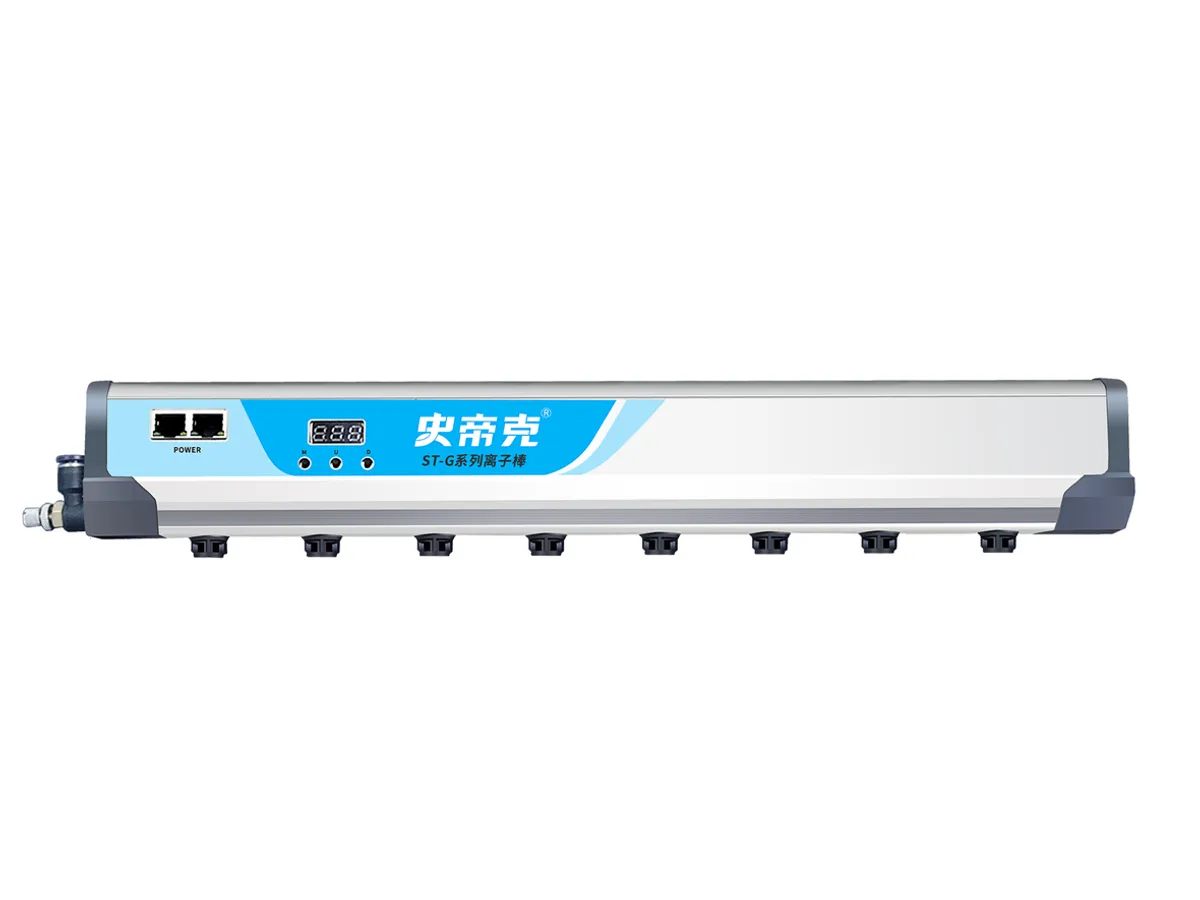
ST-G
ST-G Intelligent Ionizing Bar
- Ion balance ±50 V
- 6.5 kV pulse output
- 30–1000 mm
- DC 24 V · 12 W

ST-E
ST-E Intelligent Ionizing Bar
- Ion balance ±80 V
- 6.5 kV DC pulse
- 30–1000 mm
- Alternating fixed-polarity pins

ST-F
ST-F Intelligent Ionizing Bar
- Rated 2.5× a conventional bar
- Ion balance ±100 V
- 6.5 kV DC pulse
- 30–1000 mm
Ionizing Air Blowers & Anti Static Blowers
Ions carried to the target on moving air, reaching farther than a bar. For workstations, enclosures, and irregular parts. The ionizing air blowers page compares the four models side by side and gives the decay figures with the distance each was measured at.

ST-S200
ST-S200 Mini Ionizer Fan
- 450 × 450 mm coverage
- ≤1.5 s at 150 mm
- ≤48.2 CFM
- CE · 1-year warranty
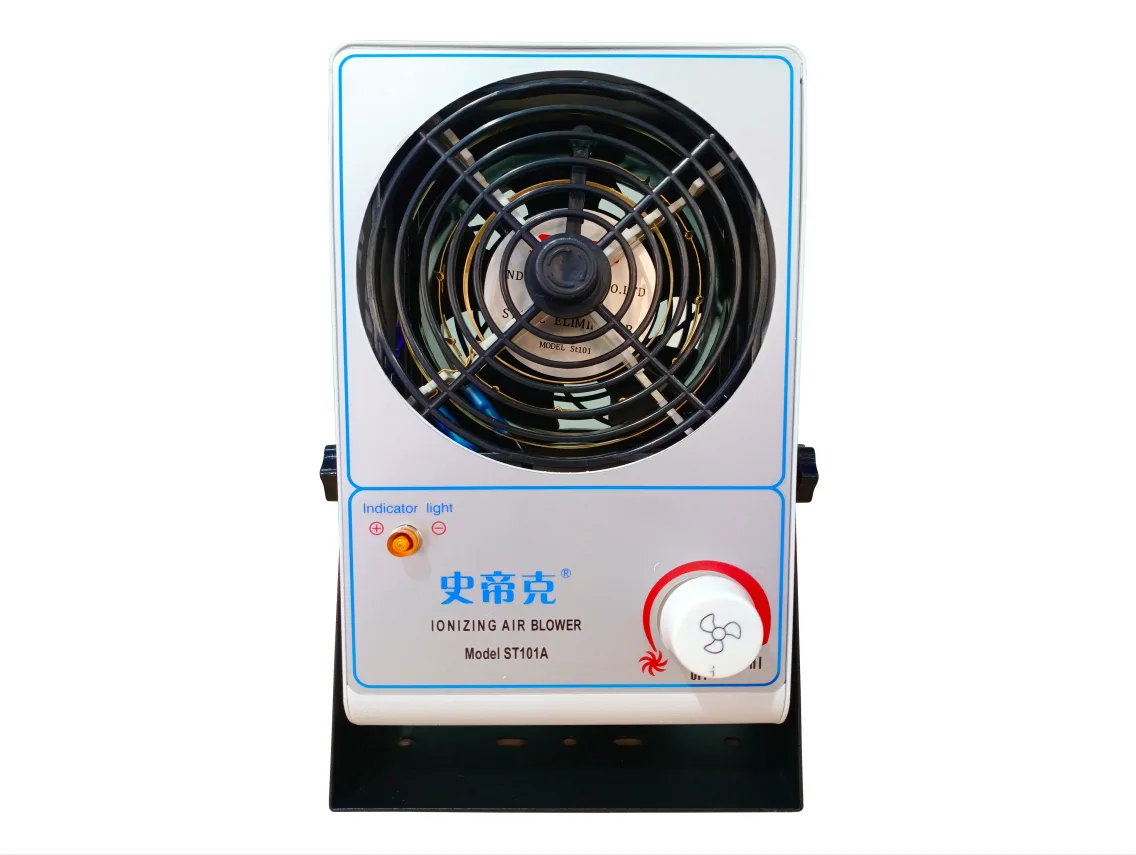
ST101A
ST101A Desktop Ionizing Air Blower
- 45–110 CFM
- Ion balance 0 V ±10 V
- 40 × 60 cm
- 3.3 kg

ST104A
ST104A Horizontal Ion Blower
- 70–120 CFM
- Ion balance 0 V ±10 V
- 60 × 120 cm
- 5.8 kg

ST1200
ST1200 Horizontal Ion Fan
- 150–360 CFM
- Ion balance 0 V ±10 V
- 140 × 120 cm
- 40–80 W
What to send for a model recommendation
Bar length is made to order, so a recommendation needs the real process — and on most lines the answer is an industrial static control system rather than one bar: a bar at each point where the material separates, sized to the width, plus a blower where a bar cannot be fitted. Send these and Shidike will return the models, bar lengths, mounting positions and unit count:
- Material and target width
- Line speed
- Measured surface voltage, or the problem you are seeing
- Ionizer-to-target distance and available mounting space
- Required PLC, alarm, or machine-control signals
Send your application details →
Common questions
What is an anti static bar?
An anti static bar — also called an ionizing bar, ionizer bar, static eliminator bar, static control bar, or ionising bar in British English — removes static electricity from material surfaces by delivering balanced positive and negative ions. Grounding drains static charges from conductors; an anti static bar is what you use on insulators such as plastic film, polarizer sheets, PCB laminate, packaging webs, and moulded parts that cannot be grounded directly.
How does a static eliminator work?
A static eliminator applies high voltage to a row of emitter points, ionizing the surrounding air by corona discharge. Positive and negative ions drift toward the oppositely charged surface until its voltage falls toward zero. The process is self-limiting: once the surface reaches neutral, ion uptake stops. Shidike bars are rated 6.5 kV pulse output at 12 W. How that pulse is applied differs by series — pulsed AC on the ST-G, pulsed DC on the ST-E and the ST-F — and ion balance is ±50 V on the ST-G, the tightest in the range.
What is an industrial static eliminator?
An industrial static eliminator generates balanced positive and negative ions that neutralize electrostatic charge on insulating materials and production surfaces that cannot be grounded directly.
When should I use an ionizing bar instead of an ion blower?
Use an ionizing bar for wide or continuously moving targets such as conveyors, films, sheets, and web lines. Use an ion blower or fan when ionized airflow must reach a workstation, enclosure, or target positioned farther away.
What information is needed to select an ionizing bar?
Provide the material, charged area width, line speed, installation distance, measured voltage, available mounting space, environment, and required machine-control signals.
How are ionizing bars maintained?
Inspect and clean emitter points at intervals based on the contamination level, confirm grounding, and verify neutralization performance with a suitable static field meter or charged plate monitor.
What is the difference between an anti static bar and an ionizing bar?
There is no difference. Anti static bar, ionizing bar, ionizer bar, static eliminator bar, and static control bar all describe the same device. Regional and industry habit decides which term is used.
What voltage does an anti static bar output?
Shidike bars are rated 6.5 kV pulse output, generated inside the bar from a DC 24 V supply at 12 W — that figure is the high voltage reaching the emitter pins, not the supply you wire up. How the pulse is applied differs by series: pulsed AC on the ST-G, pulsed DC on the ST-E and the ST-F. Ion balance is a separate figure — ±50 V on the ST-G, ±80 V on the ST-E, ±100 V on the ST-F — and it describes the offset of the bar itself, not the residual surface voltage left on your material, which your process defines.
How close should an anti static bar be mounted to the material?
Anywhere from 30 mm to 1000 mm — the same working range on all three bar series. Closer mounting speeds up neutralization; the 1 m upper limit is what lets one bar cover a gantry or an overhead position where a closer mount is impossible.
Can an anti static bar be used in a cleanroom?
Yes. Bar-type static eliminators are used in display, optical film, semiconductor, and PCB cleanrooms. Confirm the required cleanliness class and the mounting method before selecting a model.
Does static control equipment need compressed air?
The ST-G, ST-E and ST-F bars operate without compressed air. Air-assisted models are available where the target sits beyond the 1 m working range.
Which industries use anti static bars and ionizing air blowers?
Electronics, PCB and SMT assembly; optical film, polarizer, LCD, OLED and display manufacturing; packaging, printing, labelling and converting lines; plastics, injection moulding and rubber processing; and textile, nonwoven, lithium battery and photovoltaic production. Any process handling an insulating material at speed will build a charge that has to be neutralized.
Do anti static bars prevent electrostatic discharge damage?
Yes. Uncontrolled electrostatic discharge damages components on SMT and PCB assembly lines, and electrostatic attraction pulls dust back onto surfaces that have just been cleaned. Neutralizing the surface charge removes the cause of both. Verify the result with a static field meter or charged plate monitor rather than assuming it.
What is the difference between an anti static blower and an ionizing bar?
An anti static blower carries ions to the target on moving air, so it reaches farther and suits workstations, enclosed machines, and irregular parts. An ionizing bar mounts close to the material and neutralizes across a fixed span, which suits conveyors, films, sheets, and web lines.
How much area does an ionizing air blower cover?
Shidike anti static blowers range from 45 to 360 CFM. The ST101A covers 40 by 60 cm at a workstation, the ST104A covers 60 by 120 cm, and the ST1200 covers 140 by 120 cm for wide lines. The ST-S200 mini ionizer reaches 150 to 450 mm.