
Reading a Surface Particle Inspection Report: Count, Area and Size
A surface particle report may list a count, an inspected area and a size range. Before using it to discuss film cleaning, check what each field means. A larger total does not automatically mean a higher particle concentration, and a small reported size is not a cleaning-machine capability.
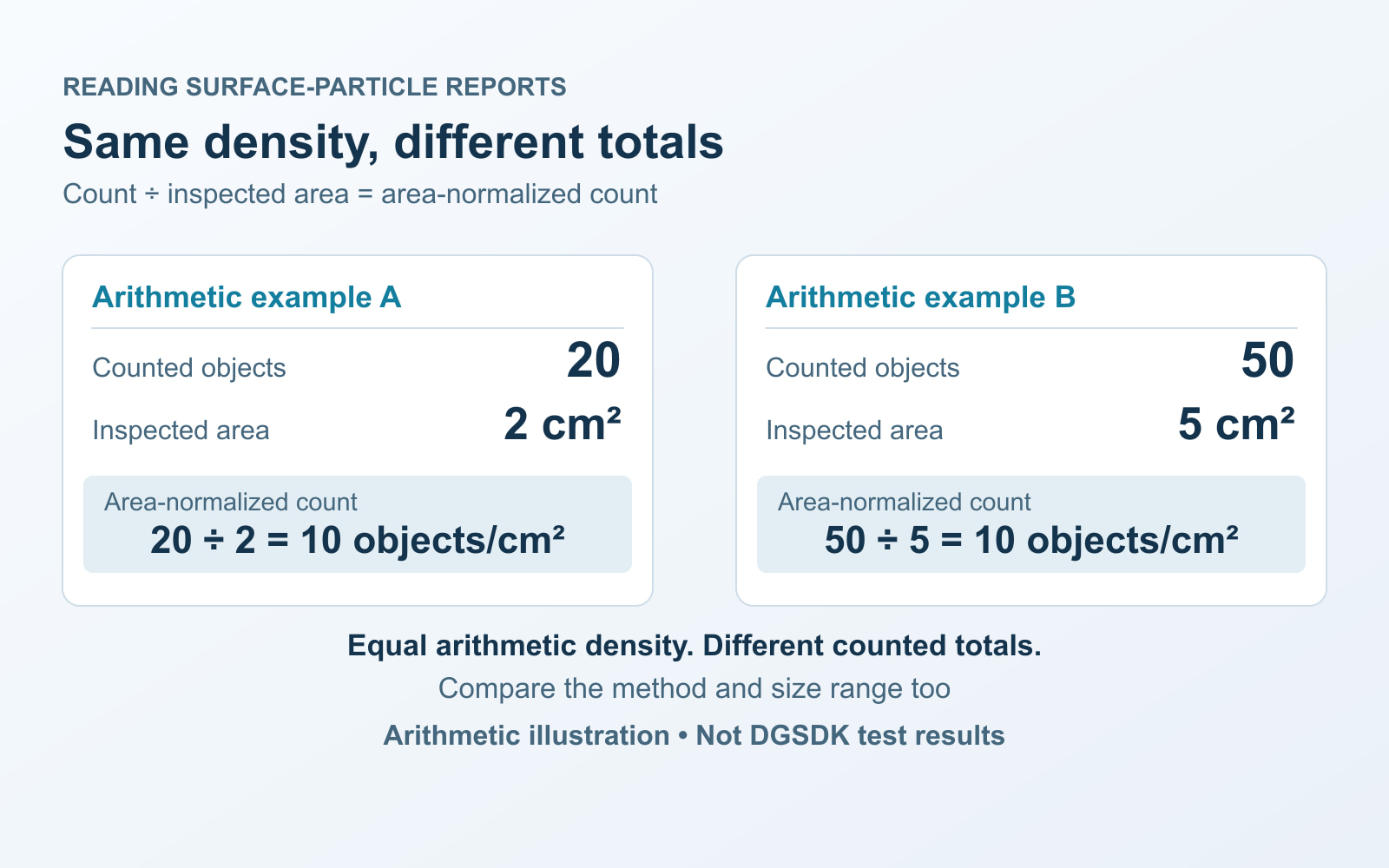
Original arithmetic illustration, not DGSDK test results or a before-and-after cleaning comparison. Equal calculated density does not establish comparable inspection methods or size ranges.
Keep the inspected area beside the count
For a count per unit area, divide the included count by the area actually inspected. Keep that denominator distinct from the nominal area of a sample sheet or an entire roll.
| Arithmetic example | Counted objects | Inspected area | Count per area |
|---|---|---|---|
| A | 20 | 2 cm² | 10 objects/cm² |
| B | 50 | 5 cm² | 10 objects/cm² |
The examples have different totals but equal arithmetic density. They contain no evidence about a cleaner, removal efficiency or which material is more suitable. Comparing actual reports would also require compatible methods and size ranges.
Ask which fields were inspected, whether fields overlap, and how excluded regions enter the area calculation. A useful report preserves the count and area alongside the normalized value. Otherwise, the denominator disappears when a single summary number is copied into an email.
Read the size descriptor, not just the unit
An area-equivalent diameter describes a circle having the measured object's area. NIST's particle-image analysis study uses this calculation for nanoparticle micrographs on textiles; it does not make an irregular object circular.
The ImageJ 1.46r guide describes Feret diameter as a maximum caliper dimension. Its Analyze Particles Size filter uses area, not diameter. Spatial calibration connects image pixels with physical units.
Before comparing two size columns, request their definitions and units. Keep the original column labels in your review notes. An unlabeled size range should remain unresolved until the laboratory explains it.
Ask how an object entered the result
The NIST study shows that changing the image threshold can change calculated size, and adjoining particles can appear as one object. Its example also excludes objects cut by image edges. These are observations from that imaging workflow, not prescribed settings for industrial film.
Where available, review the retained image and object outlines. Ask how merged objects, partial edge objects and manual exclusions were handled.
A reporting cutoff is not a validated detection limit
Ask what the report's lower limit means: an output filter, an imaging specification or separately demonstrated detection capability. These are different claims; request the evidence for the stated meaning.
Apply the same discipline to “none detected.” Record it with the inspected regions, method and reporting rules. Do not rewrite it as “no particles anywhere on the film.” Missing observations are not positive evidence about uninspected material.
Count and area fraction answer different questions
ImageJ documents count and area fraction as distinct outputs. For a thresholded image, area fraction is the percentage of the selected region's pixels meeting the threshold. It is not objects per square centimetre.
Keep those headings separate in a comparison sheet. A tally and a coverage percentage cannot substitute for each other; neither alone establishes cleaning efficiency or acceptance for lamination.
Turn missing context into questions
The public scope of ISO 14644-9:2022 concerns surface particle cleanliness assessment in controlled environments. It does not supply process-specific suitability requirements or cleaning procedures. Citing its title is not evidence that a report complies with it.
For your next report review, keep these questions with the original document:
- Which material lot, face and locations do the observations represent?
- Are the count, inspected area, units and size descriptor explicit?
- Are object selection, exclusions and the stated lower limit explained?
- Which comparisons remain unsupported, and who can clarify them?
These are proposed reading questions, not a test standard. For preparing material, see coated-film cleaning trial samples. For handling history, see recording stops and transfers before lamination. Keep those records alongside the inspection report rather than inferring a cause from its totals.
Frequently asked questions
Can I compare particle totals from different inspected areas?
Retain both the count and inspected area, then calculate count per unit area if appropriate. Matching arithmetic density does not establish matching methods, size ranges or representative sampling.
Does a reporting cutoff prove a detection limit?
No. Ask what the limit means and what evidence supports it; do not assume detection performance.
Does none detected mean a film is free of particles?
No. It describes the reported observation within the inspected regions, method and inclusion rules. It does not establish absolute absence across the entire film or roll.
Discuss your surface-cleaning application
Share the material, process stage and original inspection report, including its method and limitations. Our team can discuss the application and the information needed for an equipment review.
Explore Surface Cleaning Equipment →Discuss Your Inspection Report →