
Surface Resistance vs Surface Voltage: Reading Film Test Results
A film certificate lists resistance in ohms. A line operator reports a static reading in volts. These results answer different questions. Before treating them as contradictory, identify what each instrument measured and what the test conditions allow you to conclude.
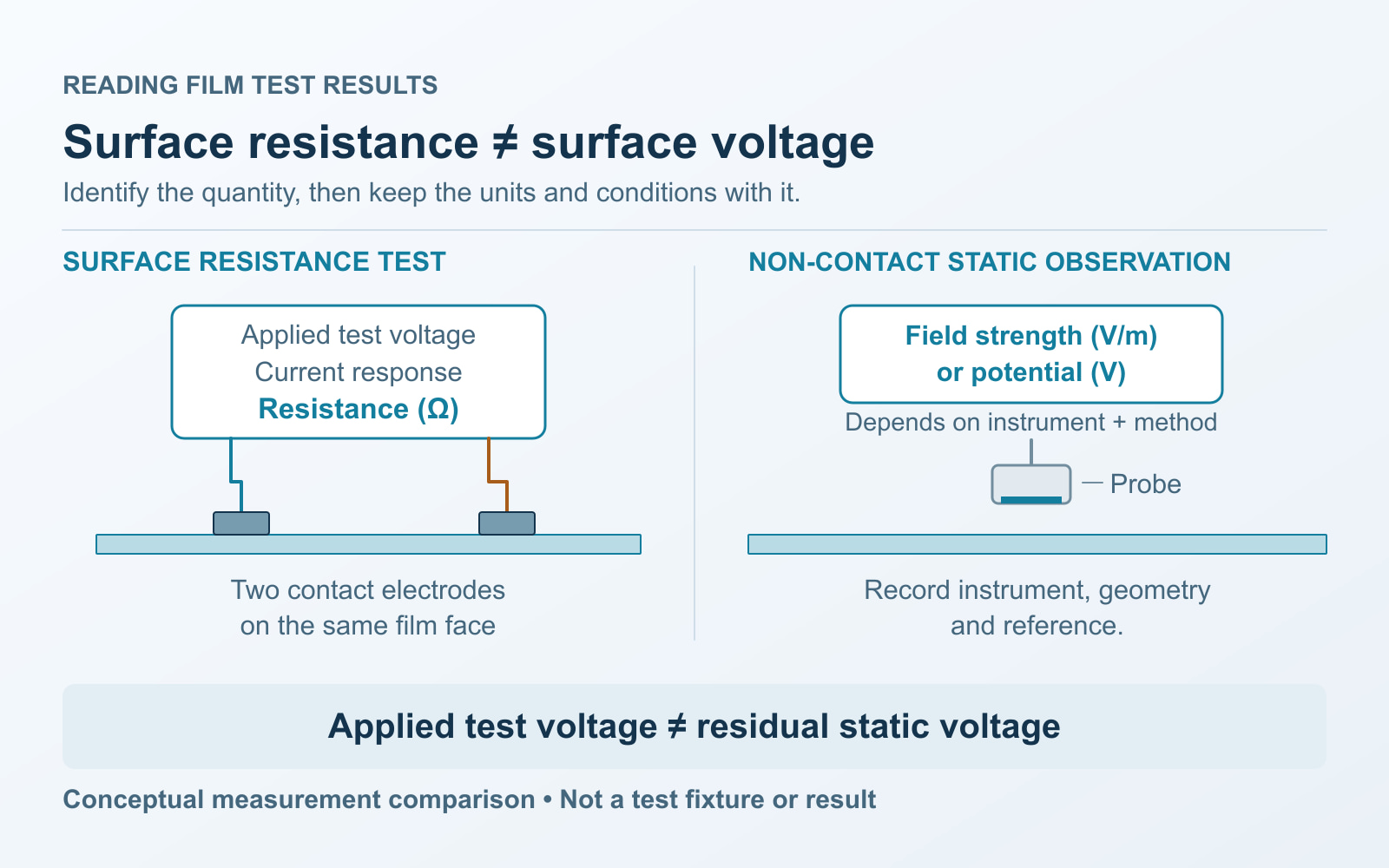
Original conceptual measurement comparison. The contact arrangement and probe are illustrative, not a specified test fixture. No measured values, instrument performance or film-test results are shown.
The voltage in a resistance test is an input
The resistance tester applies voltage and measures current through the selected electrode arrangement. Its applied voltage is not the film's pre-existing static voltage.
This distinction matters when a certificate contains both a voltage setting and an ohm result. Read the column headings before comparing either number with a handheld static reading.
| Report item | Meaning |
|---|---|
| Test voltage · V | An applied condition of the resistance measurement. |
| Resistance · Ω | The measured electrical response for the specified test arrangement. |
| Potential · V | A voltage relative to a stated reference. |
| Field strength · V/m | An electric-field quantity, not interchangeable with potential. |
Keep the method with the resistance result
ASTM D257 relates resistivity to resistance and geometry. Its public guidance identifies humidity, surface condition, applied voltage and electrification time as measurement factors. Keep the quantity and method clearly identified.
Its scope excludes moderately conductive materials. Ask your laboratory which method applies to your film.
Find out whether the static instrument reports field or potential
EOS/ESD Association's instrumentation guidance distinguishes resistance measurements from electrostatic field measurements. Many handheld field meters give a general charge indication and an approximate potential level. A display in volts does not mean every noncontact instrument measures in the same way.
Keep the instrument model, mode, displayed unit and specified measurement arrangement with the reading. A field value and a potential value are different quantities. Do not apply a universal field-times-distance conversion to an unspecified film-line geometry.
A NIST study of an electrostatic microprobe illustrates the spatial issue. In that laboratory arrangement, increasing probe separation enlarged the sensed area and reduced spatial resolution; the mapped surfaces also showed nonuniform charge. Those results do not specify a handheld meter's working distance. They explain why the observed region and geometry belong with the result.
Treat a local observation as local. Record the face, position and line state rather than describing one reading as the condition of an entire roll. For a separate investigation of readings changing along a line, see static returning after ionization.
Read two reports without forcing them into one result
Consider an illustrative document review, with no test values assumed: a supplier provides a resistance certificate with no conditioning details, while an operator provides a noncontact reading with no instrument mode or geometry. The missing context should be resolved before interpreting the reports together.
The following comparison is a reading aid, not a laboratory procedure. Ask for the original records, retain the units as written, and leave unknown fields unresolved.
| Read this field | Material test record | Static observation record |
|---|---|---|
| Quantity and unit | Resistance or resistivity, as reported | Field or potential; actual display unit |
| Object measured | Specimen ID, face and surface state | Film ID, face and observed region |
| Method and setup | Method, electrode geometry and support | Instrument, mode, reference and geometry |
| Conditions | Test voltage, reading time and conditioning | Line state, event timing and environment |
| Result boundary | Reported value and method-specific criterion | Recorded indication and comparison limits |
The appropriate review question is “What does each result establish?” An ohm value alone does not establish the film's present electrostatic voltage. A lower static indication alone does not demonstrate that the material's resistance has decreased.
Keep ionizer evaluation as a separate question
The public scope of IEC 61340-4-7:2025 addresses ionizer offset voltage and charge-neutralization decay time under specified conditions, with application-specific qualification and verification. A material certificate or spot reading does not replace that evaluation.
Keep the ionizer's offset result separate from the film's observed voltage. When reviewing equipment reports, use the ionizer datasheet comparison guide for the test conditions that need to accompany the figures.
Frequently asked questions
Is resistance test voltage the same as residual static voltage?
No. Applied test voltage and observed static voltage describe different electrical conditions.
Can a surface resistance value be converted into surface voltage?
No. An ohm value alone does not establish the film's existing electrostatic voltage.
Does a small static reading prove that an ionizing bar passed its test?
A spot reading is not an ionizer qualification report. Preserve the instrument, location and conditions, then use the applicable ionizer evaluation and application criteria to assess performance.
Discuss the static-control question on your film line
Share the material and process details together with the actual measurement records and instrument information. Our team can discuss the application and the information needed for an equipment review.
Explore Static Control Equipment →Discuss Your Film Measurements →