
Water-Break Test vs Contact Angle: What About Particle Cleanliness?
A cleaning review may include a water-break result, a contact angle and a particle inspection report. They can all be useful, but they do not answer the same question. Read the measured property before deciding whether a result addresses the contamination you wanted to remove.
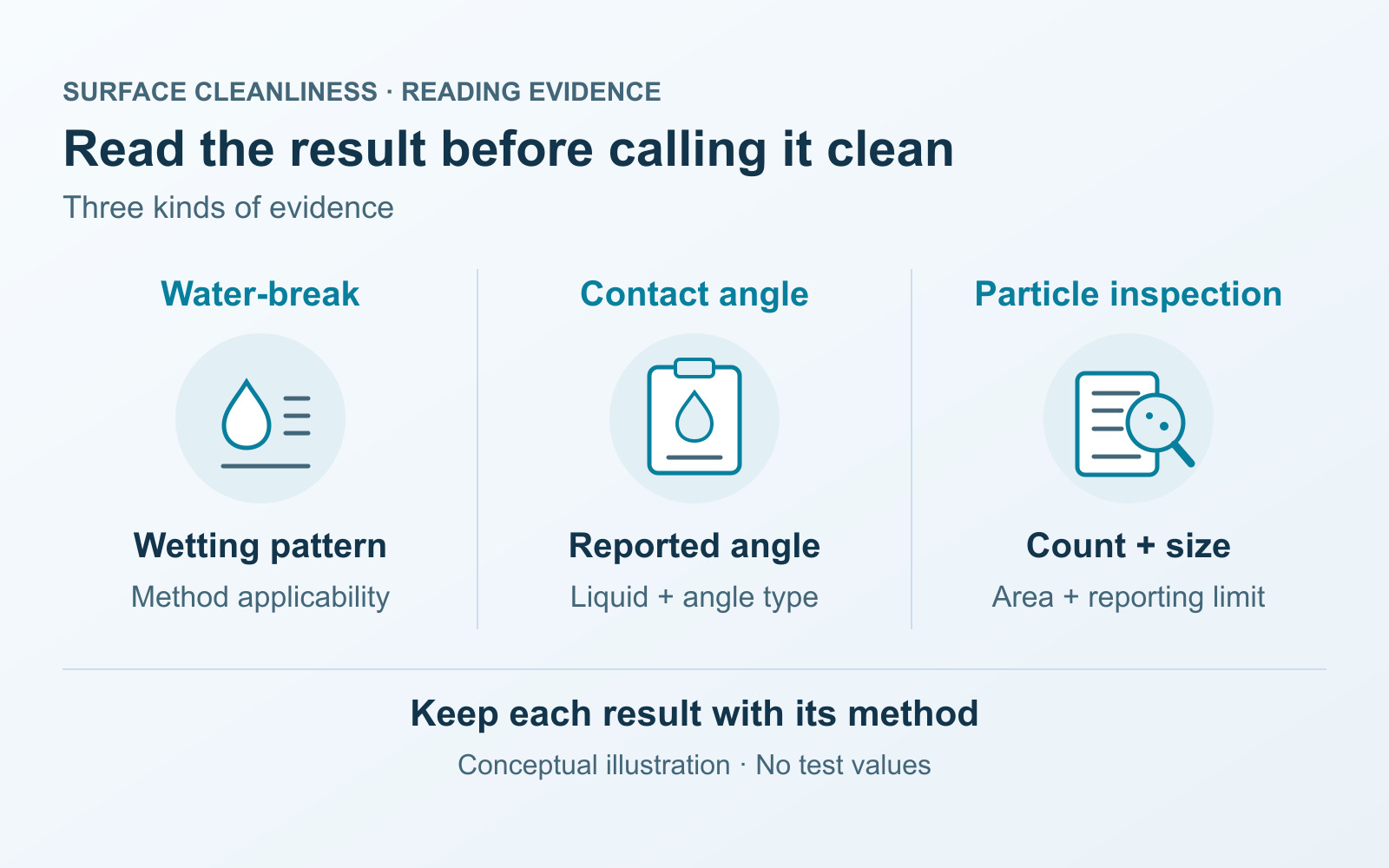
Original conceptual illustration. Three kinds of evidence; keep each result with its method. No test values.
Water-break testing concerns a wetting observation
The public description of ASTM F22-21 concerns detecting hydrophobic surface films. It describes a qualitative assessment, commonly used for a pass/fail decision. This is a different output from counting particles.
Before interpreting a reported pass, establish which material face, method and acceptance requirement it refers to. Do not assume a procedure used on a metal part is suitable for a coated film or assembled board. This article interprets records; it is not an instruction to wet your product.
A contact angle needs its measurement context
The public scope of ASTM D7334-08(2022) covers advancing contact-angle measurements. The reported angle concerns wetting by the test liquid; it does not directly provide a surface-tension value. The public description also distinguishes an observed difference from identifying the chemical groups responsible, which requires other analysis.
Keep the liquid and angle type with the result. A smaller number is not, by itself, a particle-removal percentage or a universal release criterion.
Keep particle and residue requirements separate
The IEST-STD-CC1246E overview treats particles and molecular residue within product-cleanliness requirements. It places those requirements in the context of the application and agreed limits, rather than imposing one requirement on every product.
Our interpretation of these different measurement scopes is straightforward: a wetting result does not directly supply particle numbers or sizes. Equally, a lower particle count does not establish a particular wetting condition or chemical-residue result. Avoid renaming either observation as a general “cleanliness score.”
Read the result without adding a missing conclusion
These are hypothetical report-reading examples, not factory results or a prescribed test plan.
| A report says | Keep with that result | Do not infer |
|---|---|---|
| Water-break assessment passed. | The applicable method, material face and decision rule. | Zero particles across the product. |
| Contact angle changed. | The test liquid, angle type and compared surface locations. | The identity or quantity of contamination removed. |
| Fewer particles were reported. | The inspection method, area, size definition and reporting limit. | That a wetting, chemical-residue or bonding requirement also passed. |
For the counting details, see reading a surface particle inspection report. Keeping that evidence separate avoids replacing a specific result with a broader claim it did not test.
Use three questions in a cleaning review
- What was the required outcome? Copy the requirement and its document reference into the review. If it is missing, ask the responsible process owner.
- Which record actually addresses it? Attach the report, sample identity and method. Mark unanswered requirements as unresolved rather than borrowing a pass from another test.
- What else is needed for the decision? Assign an owner to missing evidence and record the decision basis. Do not treat an incomplete record as an equipment-performance claim.
These are proposed review questions, not a standard procedure. Preserve material identity using the coated-film sample preparation guide. If the task involves flux or other residue removal, first clarify the process boundary in dry PCB cleaning versus flux removal.
Frequently asked questions
Does a water-break pass mean there are no particles?
No. A wetting observation does not provide a particle count or size distribution. Keep the particle inspection result separate.
Does a contact-angle change identify the contamination?
No. The angle alone does not identify the chemical substance responsible for a difference; that needs other analytical evidence.
Which result should support a dry particle-cleaning review?
Use particle evidence suited to the material and agreed requirement. Keep its inspection method, area and reporting limits attached to the result.
Match the cleaning discussion to your requirement
Share the material, process stage, contamination concern and available inspection records. Our team can discuss the dry particle-cleaning application and the information needed for an equipment review.
Explore Surface Cleaning Equipment →Discuss your cleaning evidence →