
Triboelectric Series for Plastic Film: Read the Conditions Behind the Ranking
Suppose a buyer finds two material names close together on a triboelectric chart and proposes changing a roller cover. Before treating that change as a solution, establish what the chart compared and which surfaces would actually meet on the line.
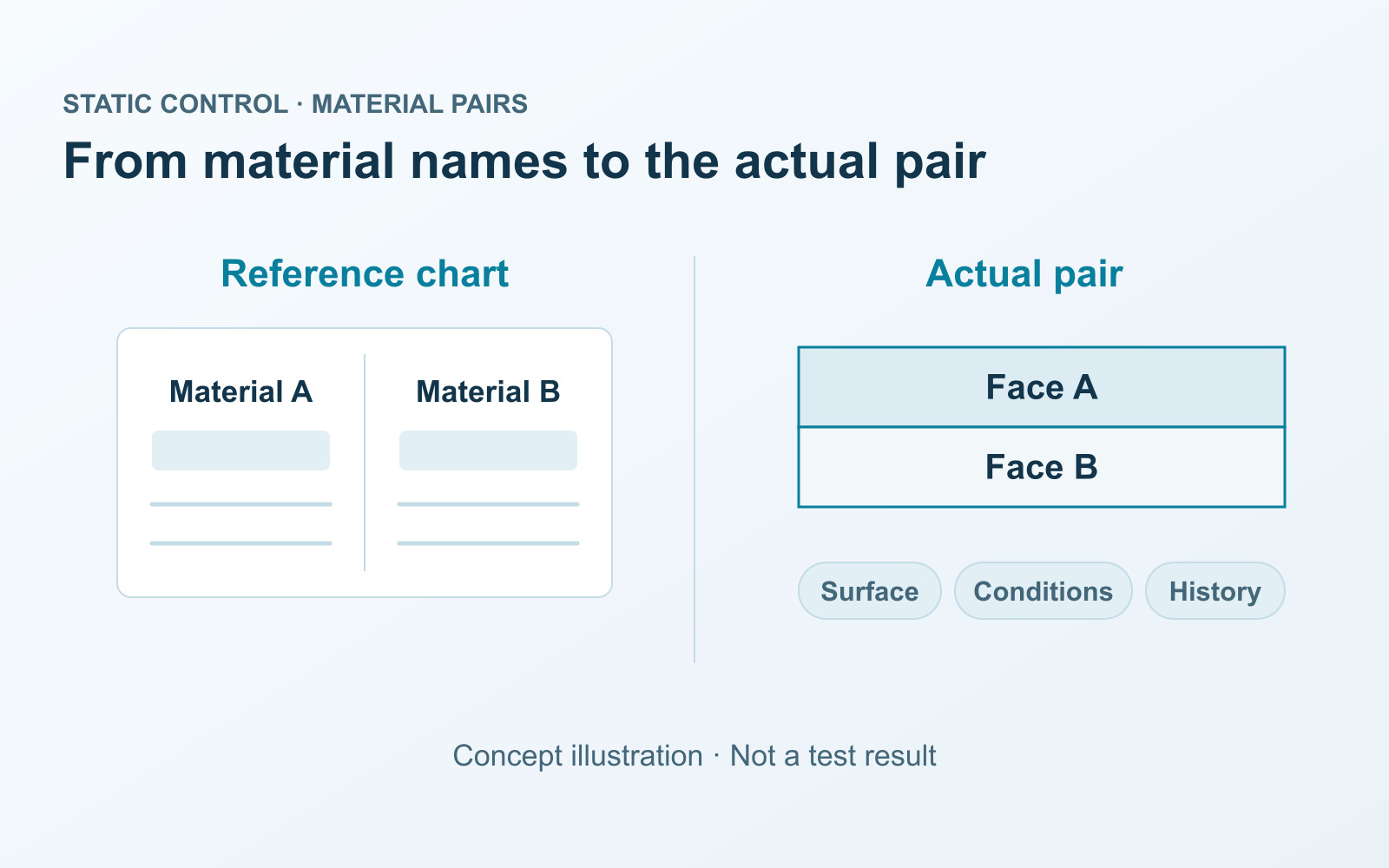
Original concept illustration. Material names and faces are placeholders; no ranking or test result is shown.
Read the comparison behind the material names
A triboelectric series orders materials by their relative charging tendency after contact and separation. The EOS/ESD Association's introduction to ESD treats these tables as general guidance: charging depends on conditions including contact area, separation speed and environment.
Keep the chart's source and explanation together. If it gives only material names and a positive-to-negative arrow, leave unreported conditions marked as unknown. A row in a reference chart is not an application voltage measurement.
Keep a study attached to its specimens
A 2025 Nature study examined nominally identical polydimethylsiloxane (PDMS) specimens. Their charging relationships evolved with repeated contact, and contact history influenced the ordering that emerged. This was a controlled material study, not a comparison of commercial production films.
It provides a reason to ask about sample history behind a ranking. It does not assign a polarity to your film or specify how many contacts would change its behaviour.
Apply the reference to one proposed pair
Consider this hypothetical purchasing discussion: the film is described as polyester, but the intended contact face has a coating. The proposed roller has a replaceable cover whose grade has not been supplied. A chart naming polyester and a generic rubber has not yet identified this proposed pair.
Use these original comparison questions before writing the selection rationale:
- Which two surfaces would meet? Identify the film's exposed coating and the roller-cover grade. Keep an unknown identity visible instead of substituting the base-film name.
- What did the reference compare? Ask whether its material descriptions and stated conditions address those surfaces. Keep differences explicit rather than relabelling the proposed pair as the published one.
- What decision needs evidence? State the proposed change and the application result it is intended to improve. Ask the trial team what comparison would support that decision.
In this example, the cover remains a candidate for evaluation. The buyer can request its material information and discuss a trial without claiming that a chart has already established its performance. The example supplies no measured result or preferred cover material.
Separate selection from a later investigation
A material-selection question asks whether the proposed pair has suitable supporting evidence. An existing-line problem needs its own observations. For charge observed after an ionizer, our recurring-static investigation article covers the next contact or separation and measurement context.
If the discussion includes an electrical reading, use the original report and its measured quantity. Our surface resistance and surface voltage guide explains those distinctions. Keep that report alongside the material reference, with a clear statement of what remains unresolved.
Discuss the material pair on your line
Share the film face, contacting material, proposed change and available observations. Our team can review the static-control application and discuss what information is needed for equipment selection.
Explore Static Control Equipment →Discuss your material pair →