
Surface Roughness and Particle Adhesion: Read the Contact Geometry
A material review proposes changing from a smooth film finish to a textured one. Will the new surface be easier to clean? Before assigning a cleaning difficulty, look more closely at what the particle actually contacts.
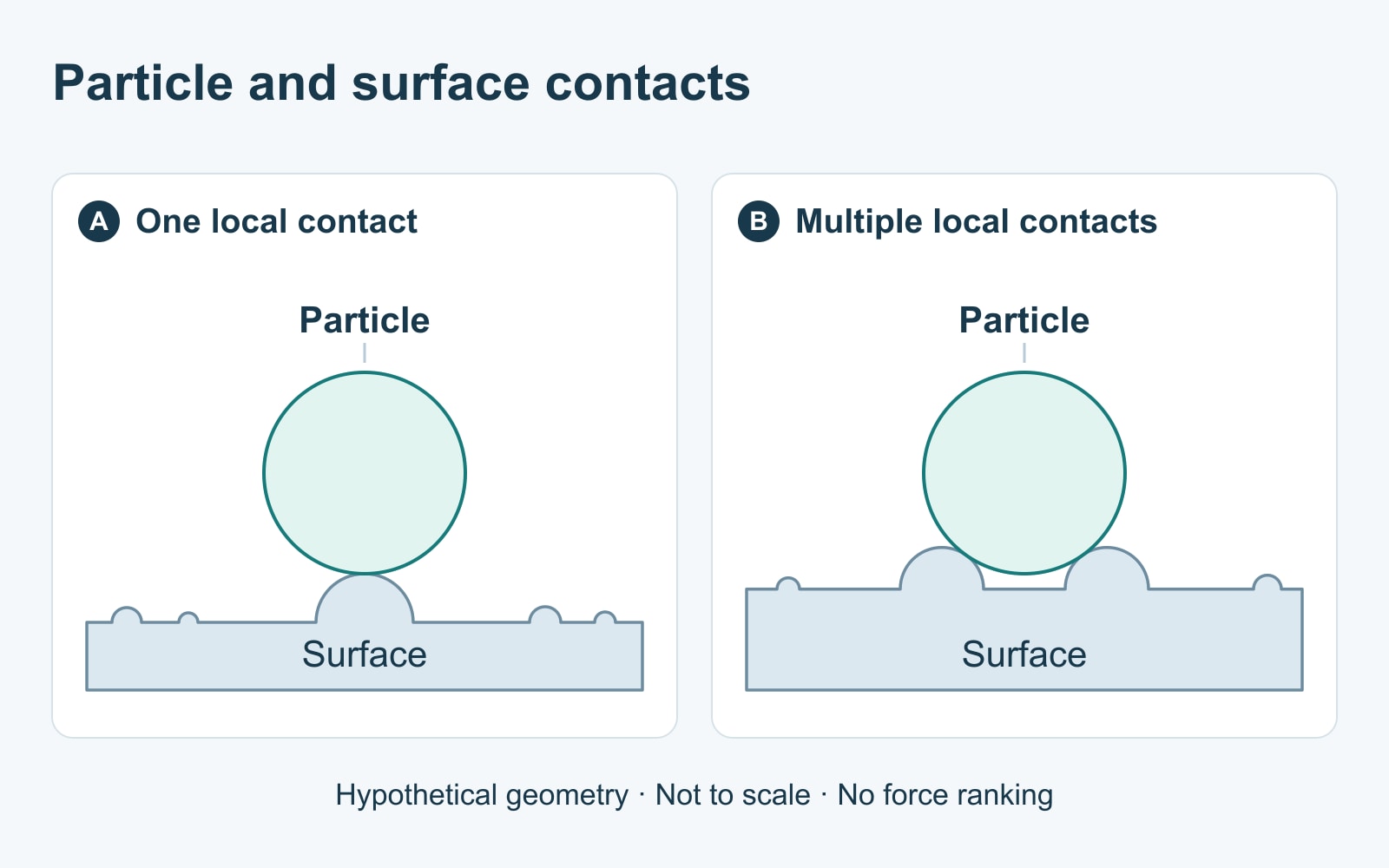
Original hypothetical cross-sections, not to scale. The panels do not rank adhesion force or cleaning performance.
Start with the local contact
An asperity is a small raised surface feature. Instead of an ideal sphere touching a perfectly flat plane, a real particle can meet local surface features. The diagram isolates that geometry: one local contact in one panel and multiple contacts in the other. It does not specify a material or reproduce a measured surface.
Two laboratory studies show why this distinction deserves attention. Both concern adhesion measurements using atomic force microscopy (AFM); neither is a production-film cleaning trial.
Roughness effects depend on the contact being studied
In Jones and colleagues' 2002 study, glass microspheres and silicon tips were tested against glass or silicon surfaces. For hydrophilic microsphere contacts, measured pull-off forces were below predictions for ideal sphere-to-flat or sphere-to-sphere contact. The authors attributed the difference to roughness and asperity contacts. This compares a measurement with an idealized model, rather than ranking two commercial film finishes.
Tormoen and colleagues' 2005 study examined glass microspheres on a deliberately structured rough surface. When particle size and surface irregularities were of comparable scale, multiple contact points could increase adhesion. The relative size of the particle and the features mattered; the word “rough” alone did not describe that relationship.
Our interpretation for a cleaning discussion is therefore conditional: a rougher surface is not automatically easier or harder to clean. These findings explain why contact geometry belongs in the question. They do not supply a universal roughness threshold or a removal-efficiency prediction.
Use the distinction in a material review
Imagine a purchasing brief for two candidate films. Film A is described as smooth and Film B as textured. A reviewer selects B because “less contact should mean easier cleaning.” No description of the contaminating particles or the exposed surfaces accompanies the brief. This is a hypothetical discussion, not a customer case.
The selection assumes the contact arrangement that it needs to establish. Neither label identifies how the relevant particles meet that film. Ask the material and trial teams to describe the actual particle/surface pairing before using a contact sketch to explain it.
The next decision is practical: keep the proposed film finish tied to the cleaning evaluation and its agreed acceptance requirement. If the team already has a trial report, use our surface-particle inspection article to interpret what was counted. For coated samples, the sample-preparation guide helps define which face enters the trial.
Connect the surface question to the cleaning method
A contact-geometry explanation is a starting point for discussing the material. Equipment selection still needs an evaluation of the proposed cleaning process on the intended sample. Our web-cleaning guide introduces the method choices; the two laboratory studies above establish no performance or compatibility claim for a Shidike machine.
Discuss cleaning for your material surface
Share the exposed surface, particle problem and proposed cleaning task. Our team can discuss the application and the information needed for an equipment evaluation.
Explore Cleaning Equipment →Discuss your cleaning application →