
Relative Humidity and Static on Plastic Film: Read Temperature Too
Suppose two shift notes show matching relative-humidity percentages but different static readings. Before deciding that humidity helped or failed, read the temperature, material and measurement context. An environmental record can help frame the investigation; it cannot supply the missing electrical result.
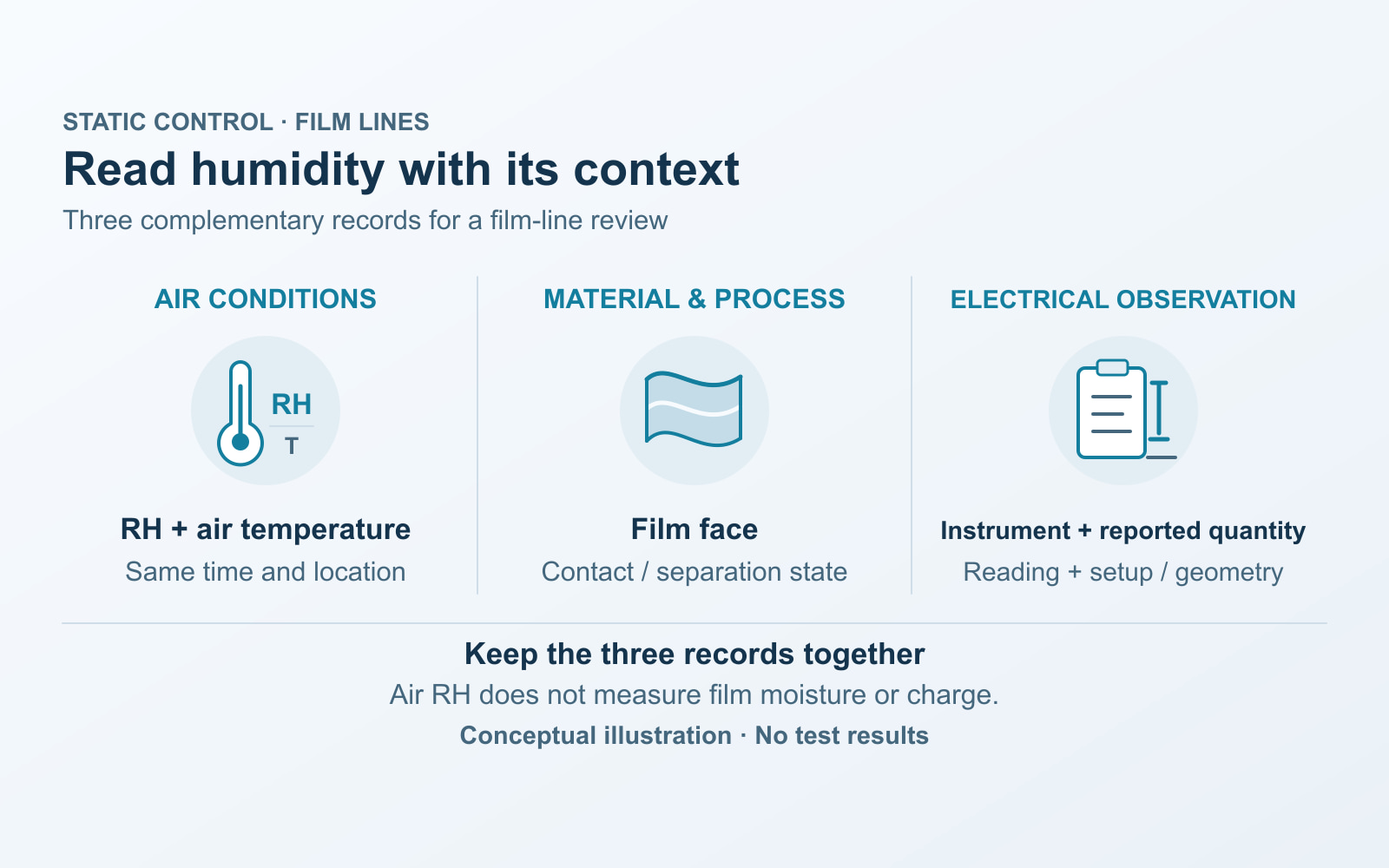
Original conceptual illustration. Three complementary records; no test results or humidity-to-charge conversion.
Read RH with the air temperature
NOAA's National Weather Service explains that RH depends on both atmospheric moisture and temperature. A matching percentage at different temperatures does not establish matching moisture content. Record RH and air temperature together, with a timestamp and sensor location.
The air sensor does not directly measure water in the film or its electrical state.
Check which humidity variable a study uses
In Xu and Grosshans' 2022 author manuscript, the charge-to-mass ratio of PMMA particles conveyed through a duct rose and then fell as absolute humidity increased. That result concerns particles under the apparatus's conditions; it is not a relative-humidity rule for moving film. Use it as a reminder to identify the plotted variable and experimental context, not as a prediction for your line.
Matching RH does not make two observations equivalent
The following pairs are hypothetical reading examples, not factory trial results or a prescribed experiment. Each exposes a different gap in a comparison.
| Illustrative record pair | What it establishes | What it does not establish |
|---|---|---|
| Same RH; different air temperatures. | Only the RH percentages match. | Equal atmospheric moisture or a common electrical state. |
| Same RH and temperature; different film faces or contact/separation states. | The recorded RH/temperature pair matches; the material/process context differs. | That humidity caused an observed difference. |
| Same recorded RH/temperature pair; different instrument modes or measurement geometry. | The electrical records were taken with different setups. | A like-for-like comparison of the electrical results. |
A later lower reading may be useful evidence to investigate, but these mixed comparisons do not identify a single cause. Preserve the observations and leave the cause unresolved.
When a shift note says “humidity normal,” ask which sensor reading and approved requirement it refers to. Leave unrecorded details marked unknown rather than filling them from another observation.
Separate operating limits, test conditions and acceptance
A humidity figure can serve different purposes. Keep its label and source document attached:
- Equipment operating conditions describe the environment in which the manufacturer permits a device to operate.
- Test conditions describe the environment used for a specified measurement.
- Process acceptance criteria define what the responsible process owner requires for the application.
An operating range is not itself a film-charge limit. Read product specifications as equipment information; they do not establish a universal production RH target.
Keep a humidity requirement tied to its purpose
The EOS/ESD Association's Humidity FAQ explains that the ANSI/ESD S20.20 framework it discusses does not rely on humidity control. If a program specifies humidity conditions, the FAQ calls for monitoring, objective evidence and a response when conditions leave the specified range. This is ESD-program guidance, not a plastic-film process specification.
Treat a site humidity limit as a documented requirement with a stated basis. A room reading alone does not justify changing or disabling existing static controls.
For the electrical terms, see our guide to film resistance and static voltage. If readings change between line positions, the static-return article addresses that separate investigation.
Frequently asked questions
What else should I record with RH?
Air temperature, measured at the same time and location.
Does higher humidity prove static control is adequate?
No. Assess the electrical observations and applicable process criteria; humidity alone does not verify control performance.
Is an ionizer humidity range a process target?
No. Separate equipment operating conditions, test conditions and the requirements used to accept your film process.
Discuss humidity in your film-line review
Share the paired air readings, material and process context, and electrical records. Our team can discuss the application and the information needed for an equipment review.
Explore ST-G ionizing bars →Discuss your film-line observations →