
Ionizer Maintenance Records: Separate Work from Verification
Suppose an ionizing bar's work order is marked “cleaning completed,” but the attached test report belongs to an earlier visit. The work may be documented correctly while the evidence for the current review is incomplete. A useful maintenance record makes that difference visible.
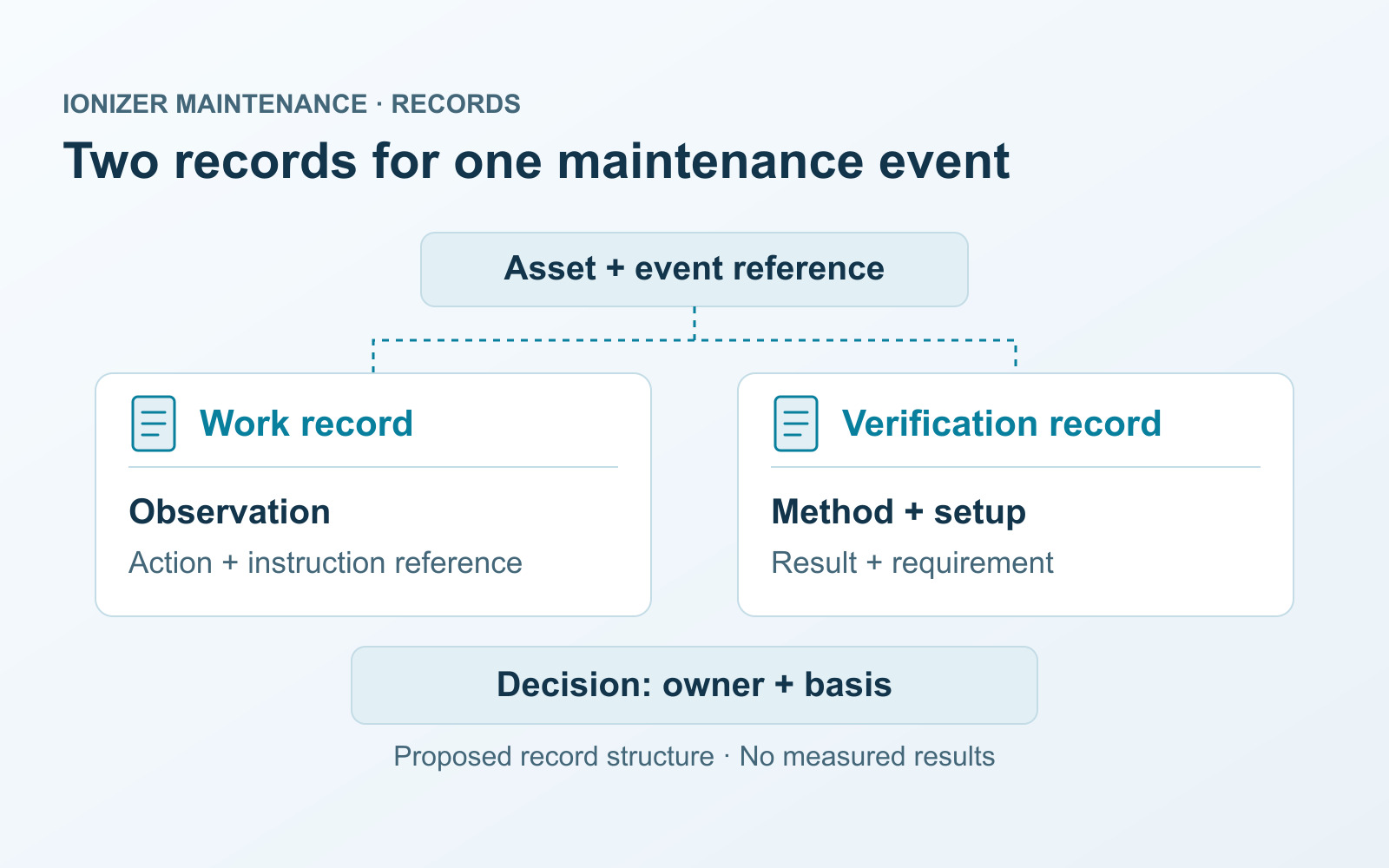
Original proposed record structure. The diagram contains no measured results or prescribed service sequence.
A work entry is different from a measurement result
The public scope of IEC 61340-4-7:2025 identifies ionizer offset voltage and decay time as measurements made under specified conditions. It also describes application-specific qualification and periodic performance verification. A note saying “cleaned” supplies neither measured result.
The ANSI/ESD SP3.3-2026 listing separately addresses periodic verification of air-ionizer performance. Its public description is not a cleaning instruction or a rule for testing after every service action.
For this record review, distinguish what someone observed, what they did and which report supports the later decision. If a check was not performed, say so. If its report cannot be found, record that different gap.
Connect the documents to the same asset and event
Give the record an equipment identifier and installed location, not just the product family. Add the maintenance date, the person who did the work and the instruction reference used. Record actual replacements, adjustments or mounting changes without inferring them from a completed checkbox.
A report from another unit, date or configuration needs that difference identified before someone uses it in the review. Keep earlier records as history; do not relabel them as checks of the present arrangement. For interpreting the measurements themselves, use our ionizer test-condition comparison.
A proposed record for one maintenance event
Use the asset and event reference above as the common heading. The table is an original documentation aid, not a standard-mandated form. Attach the actual work and verification documents rather than rewriting their procedures here.
| Entry | Record or attachment | Keep explicit |
|---|---|---|
| Condition found | Observed condition, exact displayed status and any existing report reference. | What was observed; what was not checked. |
| Work performed | Actual action, instruction reference, person, date and any changed parts or settings. | Inspection, cleaning and replacement are different actions. |
| Verification evidence | Report reference, measured quantity, method/setup, result and applicable criterion. | Attach the report, or mark the evidence unavailable. |
| Review decision | Responsible person, decision basis and unresolved follow-up. | Who will resolve each missing item. |
Example: work complete, attachment unresolved
Consider this hypothetical handover: “Inspection and cleaning recorded; verification report not attached.” Preserve the service entry and ask the named person for the report or clarification. Do not rewrite the note as either “performance passed” or “test failed.” A missing attachment does not tell you which happened.
If the report is found, check that its asset and configuration match the event being reviewed. If no check was made, record that and refer the next action to the responsible person. Do not create an earlier reading to make a before-and-after pair look complete.
Keep the decision and its basis together
Within electronics ESD programs, EOS/ESD Association's verification guidance connects assessment to defined requirements, recorded results and corrective action. That context does not establish a universal service interval or acceptance limit for every film line.
Use the maintenance instructions and verification requirements applicable to the installation. This proposed table gives no automatic permission to restart production. Where an operating problem continues after service, keep its investigation separate; our recurring-static observation guide addresses the material and process record.
Frequently asked questions
Does a completed cleaning entry prove ionizer performance?
No. It records an action. A performance conclusion needs the relevant result and decision basis.
What if the verification report is missing?
Mark the attachment as missing and assign someone to locate or clarify it. Do not invent a result.
Can this table replace the approved maintenance documents?
No. It is a proposed way to link records. Use the applicable maintenance instructions and verification documents for the actual work.
Discuss the ionizer application behind the record
Share the model, installed location, work completed and available report references. Our team can discuss the application and identify which equipment information is needed for the review.
Explore Static Control Equipment →Discuss your maintenance record →