
Compressed Air for Surface Cleaning: Particles, Water and Oil
If a proposed surface-cleaning process uses compressed air at the material, ask what air quality is required and where it will be checked. A useful brief names the contaminant groups and connects each requirement to an identified location.
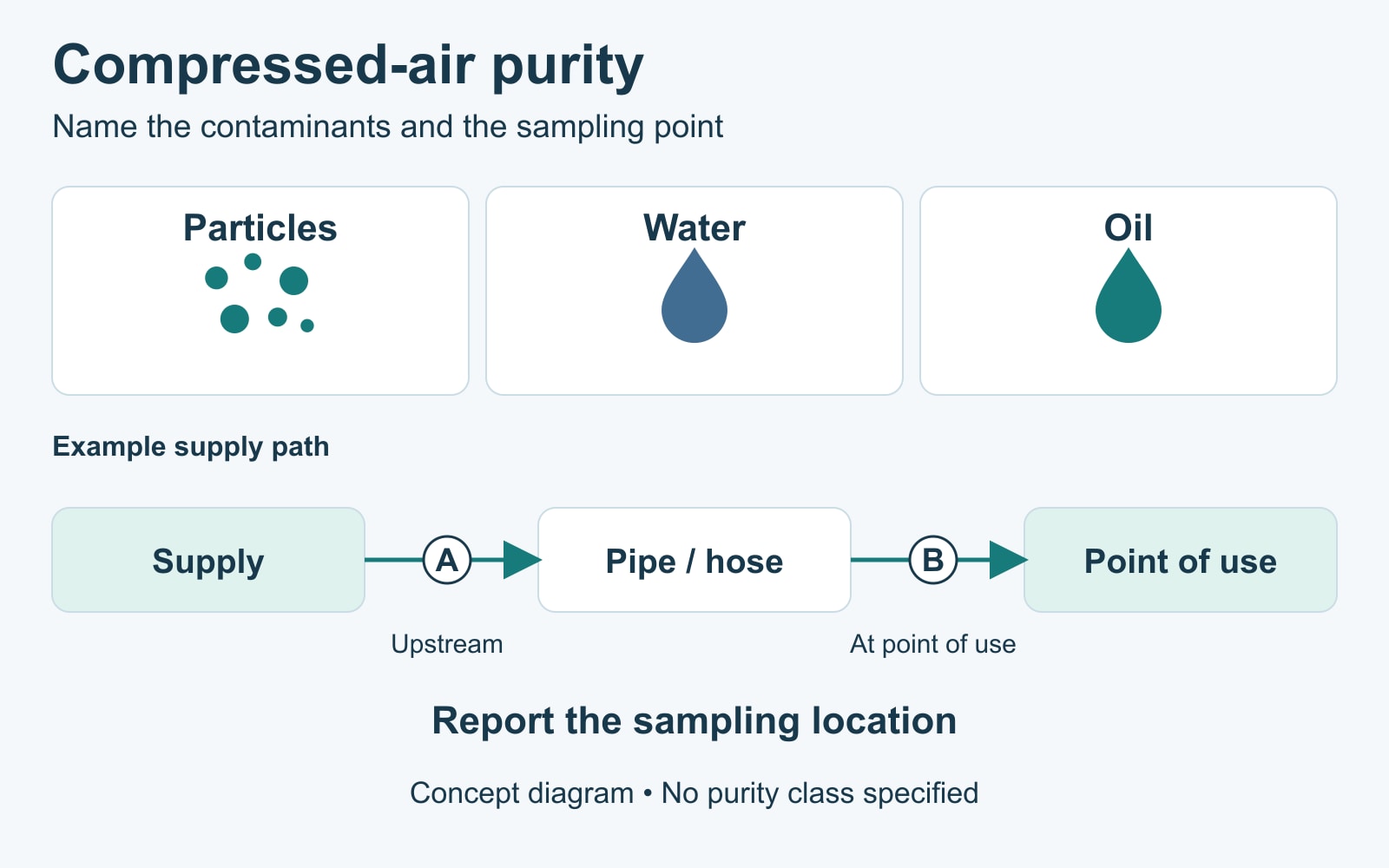
Original documentation diagram. A and B identify different locations; neither has a measured result. No purity class or equipment configuration is specified.
Read particles, water and oil separately
The official ISO 8573-1:2010 abstract describes compressed-air purity classes for particles, water and oil. It also identifies gaseous and microbiological contaminants, so the three groups are not a claim that every possible contaminant has been assessed.
The CAGI Compressed Air Purity Guide, page 3, explains the designation order: particles, then water, then oil. Keep those labels beside the class entries. A lone class number leaves the category unclear.
This article does not select a class for film, PCB or another material. The proposed equipment and application need their own documented requirements; naming the standard does not supply those missing choices.
Keep the pressure basis with a dew-point value
A water-related report may include a pressure dew point. The CAGI glossary defines this as the temperature at which water begins to condense from air at a given pressure. The pressure is part of the meaning of the value.
For example, an unlabeled temperature in a proposal needs clarification: is it a pressure dew point, and at what pressure? Retain the original quantity name, unit and pressure basis in the review. Do not silently treat an atmospheric dew point and a pressure dew point as interchangeable. No dryer setting or target temperature is prescribed here.
Match the report location to the question
CAGI's purity guide, page 16, notes that the distribution network can add contamination between the compressor room and the point of use. An upstream report therefore should not be relabeled as a result at the cleaning connection.
In an invented proposal, the report identifies A but the requirement names B. Request evidence for B; the mismatch alone establishes neither contamination nor compliance.
Use a blank brief before comparing proposals
The following is an original project worksheet, not an ISO test form. Complete it with the equipment supplier and the person responsible for the material process. Keep unknown entries open instead of assigning a generic class.
| Item | Project requirement | Evidence supplied | Open question |
|---|---|---|---|
| Particles | Class / criterion: ___ | Report / result: ___ | ___ |
| Water | Class / criterion: ___ | Quantity / unit / pressure basis: ___ | ___ |
| Oil | Class / criterion: ___ | Report / result: ___ | ___ |
| Location | Named connection: ___ | Sampling point / date: ___ | ___ |
Attach the document revision, report identifier and agreed test method rather than copying isolated figures into a quotation comparison. Identify who will resolve each open question and retain the original report with the decision.
Evaluate the material result separately
An air-purity result describes the supplied air. It is not a particle-removal percentage or proof that the cleaned surface meets its acceptance criterion. Keep the air specification and the material-trial result as separate evidence in the equipment review.
For the different question of supply pressure and particle-removal evidence, see reviewing air-jet cleaning proposals. For the broader choice between contact and air/extraction methods, see our web-cleaning guide.
Define the process before specifying its utilities
Share the material, contamination and proposed cleaning method with Shidike. Confirm the selected machine's utility requirements from its current documentation; this generic brief does not assign an air-purity class to a Shidike model.
Explore Cleaning Machines →Discuss your cleaning application →