
Air-Jet Particle Removal: Reviewing Supply Settings and Trial Evidence
Suppose two cleaning proposals list different air-supply pressures. The larger number is easy to compare, but the buying question concerns particles left on your material. A useful evaluation connects the stated supply condition to the tested surface and the observed cleaning outcome.
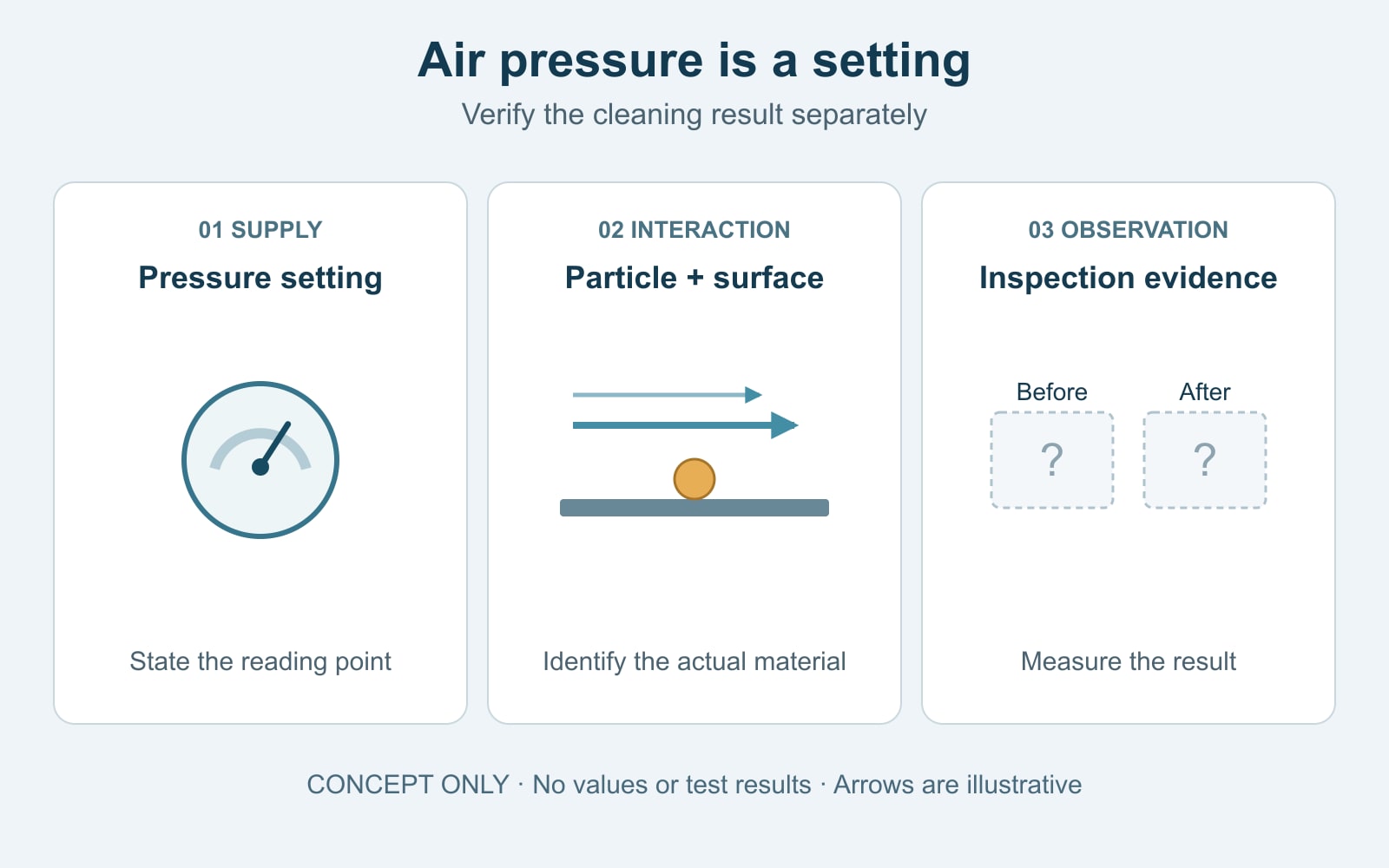
Original concept illustration. No operating values, measured removal or recommended setup are shown.
Separate the setting, the interaction and the result
First establish what the quoted pressure describes: a supply setting or a measurement, and at which point. Keep that label with the value. When a discussion moves from the supply to the workpiece, the question has changed.
The following is an original way to compare proposals, not a test method or an equation for selecting pressure.
| Part of the comparison | Question it addresses | Evidence still needed |
|---|---|---|
| Air-supply pressure | What setting or reading is being specified, and where? | The tested jet arrangement and its operating mode. |
| Particle and surface | Which particles and exposed surface were evaluated? | Whether that combination represents the proposed application. |
| Observed removal | What did the trial demonstrate on that sample? | The inspection basis and the requirement used to judge the result. |
The particle and surface belong in the comparison
In a 1998 study by Namiki, Otani and Emi, removal of spherical particles from smooth surfaces was related to fluid drag relative to van der Waals adhesion. Extending the comparison to rough surfaces required additional roughness information.
That finding concerns the tested particles and surfaces. It does not identify the dominant adhesion mechanism on an unknown production film. For a proposal using a different exposed surface, the useful question is whether the supplied evidence addresses that difference.
One fixed flow descriptor did not fix the outcome
A 2002 experiment by Ziskind and colleagues held jet velocity fixed while varying pulse frequency. Particle removal rose to a maximum and then declined. This was a particular pulsed-jet experiment; fixed velocity is not the same claim as fixed supply pressure.
The study supplies no universal pulse setting for a film line. It gives a concrete reason to identify continuous or pulsed operation when comparing otherwise abbreviated air descriptions.
A hypothetical purchasing comparison
Consider two proposals for a coated-film cleaning task. Proposal A includes a particle-removal result from a smooth, rigid laboratory sample. Proposal B lists a higher supply-pressure setting and describes a pulsed head, but includes no result on the intended coating. These are invented proposal summaries, not supplier claims or DGSDK trial data.
A's report is evidence about its tested sample. Before extending it to the film, ask which relevant material and process differences the evaluation addresses. B's setting describes part of the proposed operation; it does not establish a better cleaning outcome.
Changing the wording of B to “higher-pressure cleaning” would not close that gap. Equally, A's attached report does not automatically make A the better choice for the coated film. The comparison remains open until there is evidence suitable for the intended task.
A useful next request is specific: ask each evaluation team to explain how its proposed demonstration will address the actual exposed surface and the particle problem. Keep an untested coating or an unverified performance claim visible in the decision. Do not assign a preferred pressure from these two summaries.
Compare methods around the cleaning requirement
If the unresolved question is the cleaning method itself, begin with our web-cleaning methods guide. It distinguishes roller contact, brush cleaning and air/extraction approaches. A proposal should identify which process it actually uses before its settings are compared with another design.
For reading the trial's inspection evidence, see surface particle inspection reports. Keep the material requirement and the evidence supporting the choice together. The laboratory papers discussed here do not establish film compatibility or performance for a Shidike machine.
Discuss the cleaning method for your material
Share the exposed surface, particle problem, current process and available trial evidence. Our team can discuss the application and whether equipment in our cleaning range fits the task.
Explore Cleaning Equipment →Discuss your cleaning application →