
Airborne Particle Counts vs Surface Cleanliness: What Each Result Describes
Suppose a film processor receives two reports. The room air report meets its stated requirement, but a film-surface inspection is marked unacceptable against the customer's particle criterion. Before asking which report is wrong, check what each one sampled.
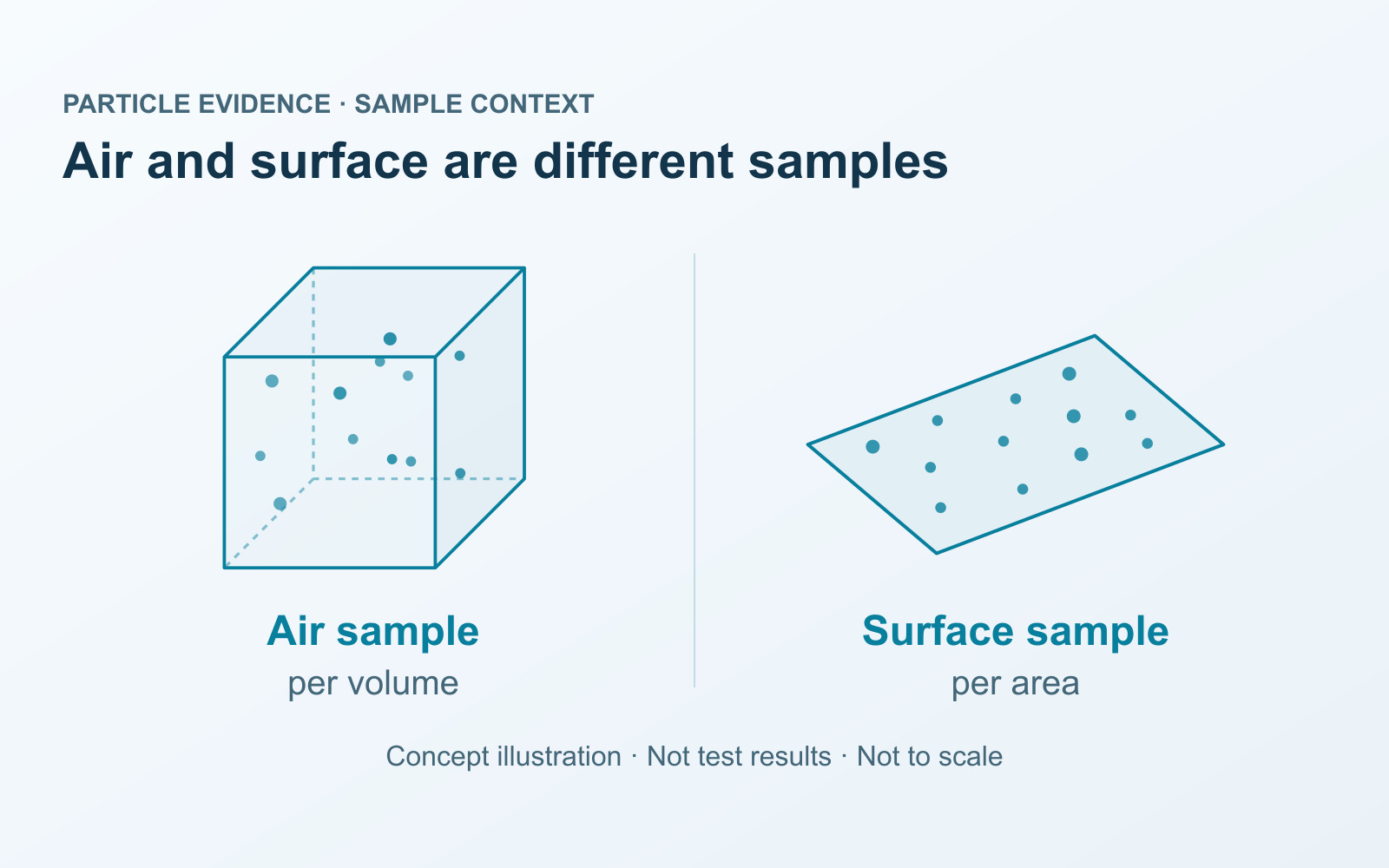
Original concept illustration. The dots are schematic, not measured counts.
Start with the sampled object
ISO 14644-1:2015 concerns air classification using airborne particle concentration at specified size thresholds and sampling locations. Its subject is air, not a particular film face.
ISO 14644-9:2022 addresses particle assessment on solid surfaces, including products. It does not prescribe surface-cleaning procedures or the cleanliness required by a specific process.
The ASHRAE Handbook's Clean Spaces chapter distinguishes air concentration used for classification from deposition on a critical product surface. An air result is therefore relevant context, not a substitute for that product's evidence.
Compare the questions, not just the numbers
This original comparison helps place each document in a review. It is not a conversion table between air and surface results.
| Report | Sample represented | Useful review question |
|---|---|---|
| Air particle report | Particles in sampled air; concentration per air volume. | Which location and operating condition does this document cover? |
| Product-surface report | Particles on the inspected surface; check the report’s area basis. | Which material face and process stage does this document cover? |
Keep the units and method with the original result. For the details inside a surface report, see count, area and size in particle inspection; those details should not be replaced by a room-class label.
A hypothetical case: one requirement met, another unresolved
Return to the opening example. The buyer has an acceptable room report and a rejected film inspection. These outcomes need not contradict one another: the reports concern different samples and requirements.
In this hypothetical review, retain both documents and ask the inspection owner to identify the film face, inspection stage and criterion behind the rejection. If the attached image belongs to a protective liner rather than the exposed film, resolve that mismatch before discussing a change to the cleaner.
Neither document, by itself, establishes how the particles reached that face. Do not turn the room result into a claim that the cleaner failed, or turn the film result into a declaration that the room classification is wrong.
Bring the product question to the cleaning discussion
For an equipment enquiry, describe the decision you need to make: selecting a cleaner for a particular material, reviewing a trial result, or investigating an existing line. Attach the relevant report and mark any missing information as unknown.
If the question concerns a film that passed through several stops or transfers before inspection, include that history. Our film-cleanliness handover guide addresses that separate task. It does not turn an uncertain history into a confirmed contamination source.
Ask for the evidence that would answer the open product question. A room certificate, an inspection image and a cleaner brochure should retain their own labels; assembling them in one folder does not make them a single performance test.
Frequently asked questions
Does a room class demonstrate cleaning-machine efficiency?
Not from the class label alone. Ask for the trial results supporting the specific removal claim.
Should I send both reports for an equipment discussion?
Yes, if available. Identify which belongs to the room and which to your material, and state the unresolved cleaning requirement.
Discuss the surface-cleaning requirement
Share the material, face to be cleaned, process stage and available inspection report. Our team can discuss the application and the information needed for a cleaning trial.