
Electrostatic Induction Near Film: An Isolated Metal Example
A film-handling layout includes a metal guide close to the web, with no intended contact between them. A useful discussion separates two questions: how is charge distributed on the metal, and has its total charge changed?
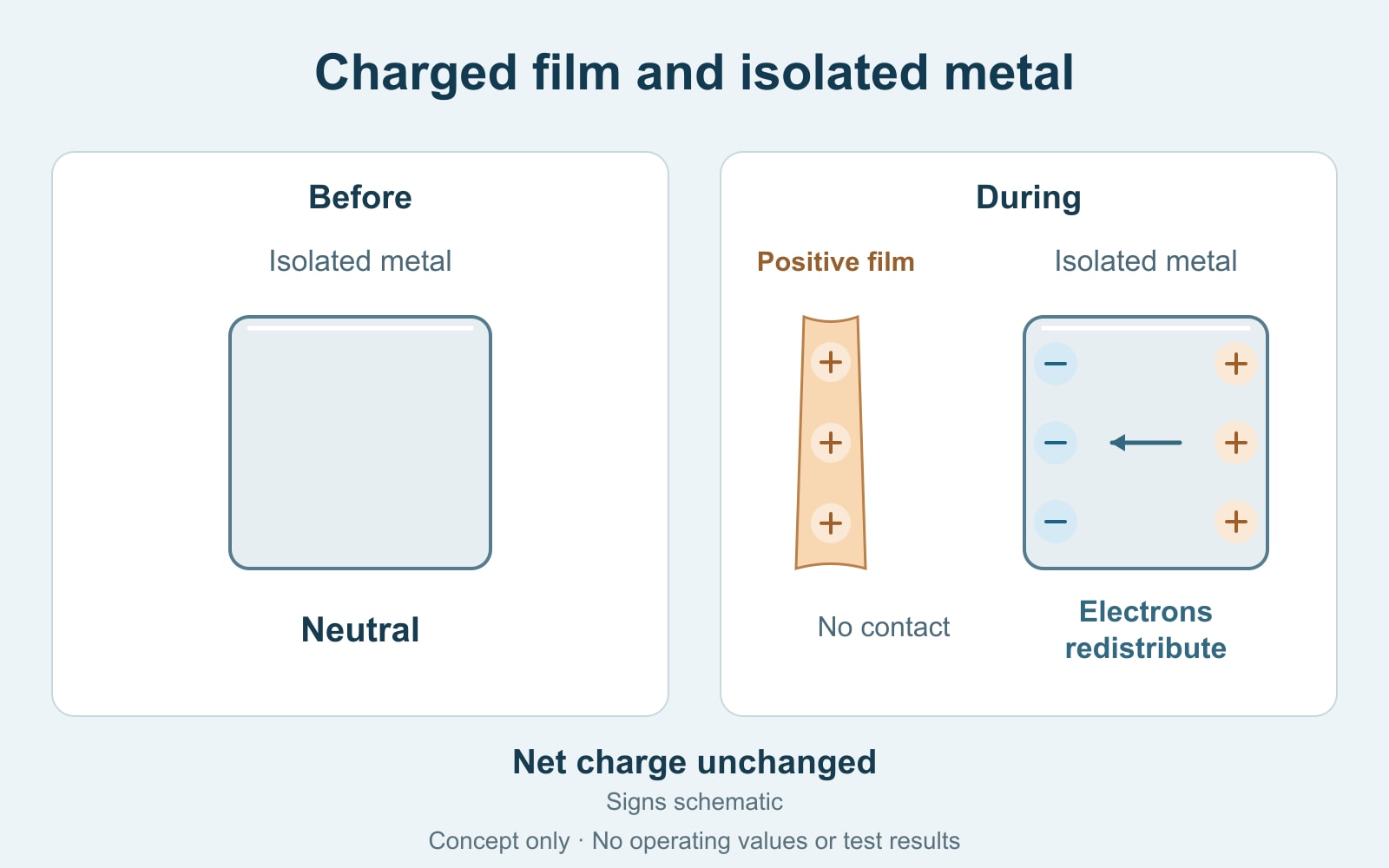
Original concept diagram. Signs are schematic; no operating values or test results are shown.
Read the isolated-metal example
Our example uses initially neutral, electrically isolated metal with no charge exchange. The positive film is a chosen illustration, not an assigned polarity for a production material.
The EOS/ESD Association's introduction explains that an external field can polarize a conductor without changing its total charge. Here, electrons move toward the positive film, leaving an electron deficit farther away.
Net neutrality does not establish zero potential or an absence of ESD risk.
Keep the model's electrical boundary explicit
A ground connection permits charge transfer, so the isolated-metal assumption no longer applies.
The association's grounding guidance also distinguishes insulators: grounding nearby metal does not establish that charge on insulating film has been removed.
This example supplies no grounding design or operating sequence. On a real line, use the identified material construction and the equipment's verified electrical arrangement; do not replace either with an assumption based on appearance.
Apply the example to one drawing
In a hypothetical design review, a drawing labels two items “plastic web” and “metal guide.” Someone proposes changing the guide because “the film charged it,” but no material sheet, connection detail or test result accompanies that explanation.
Start by checking whether the actual web construction and the guide's electrical arrangement match the example. If either is unknown, keep the explanation provisional. The schematic helps define a mechanism to discuss; it does not establish the cause of a production problem or select an ionizer.
Discuss the film and nearby metal on your line
Share the material description, nearby parts, known connections and the problem you need to investigate. Our team can discuss the static-control application and the information needed for equipment selection.
Explore Static Control Equipment →Discuss your application →