
Cleaning Rollers and Adhesive Collection Rolls: Trace the Particle Transfer
A fresh adhesive roll is only one part of a working contact-cleaning process. Follow the particles from the material to the cleaning roller, then to the collector, before deciding which part needs attention.
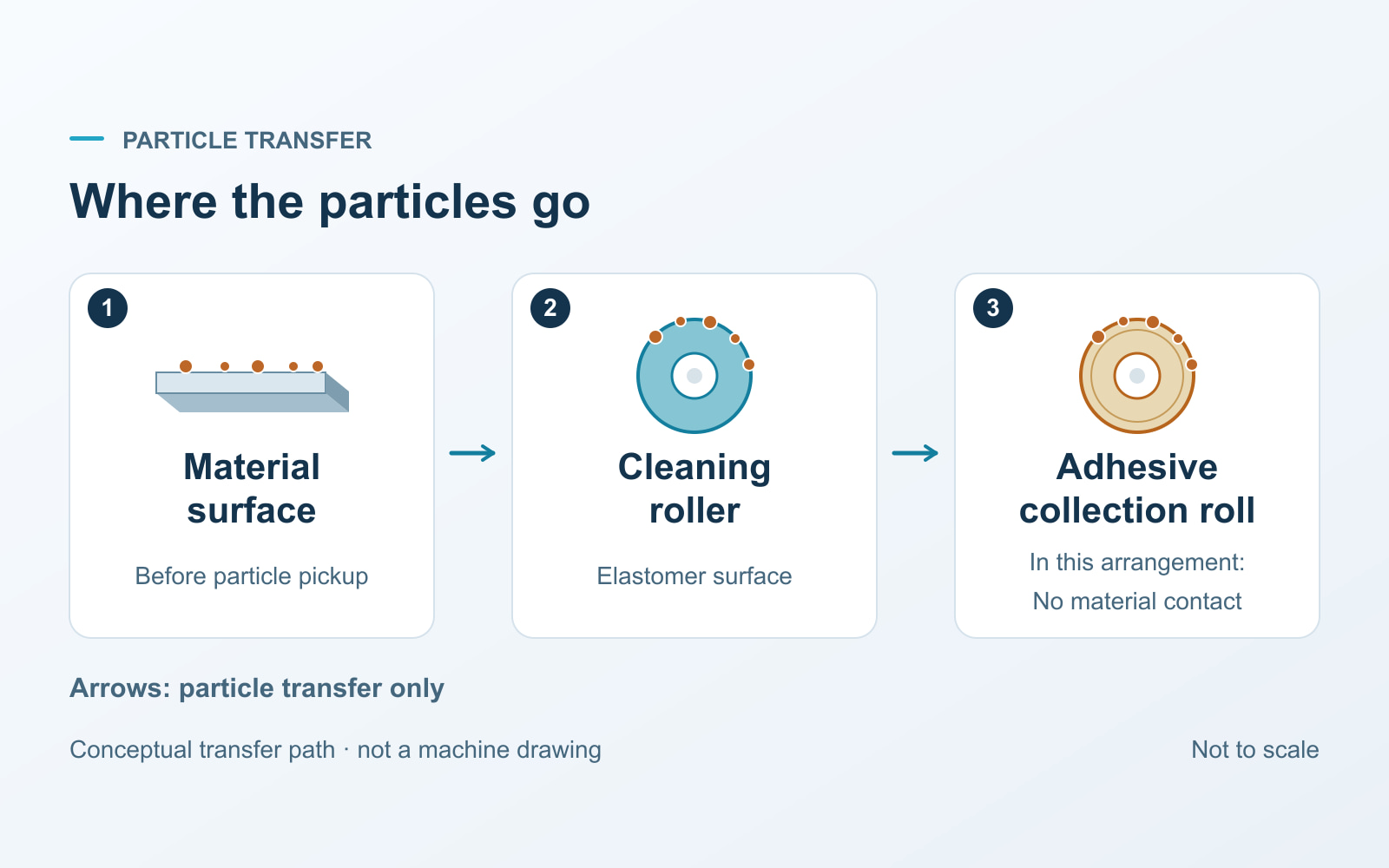
Original conceptual illustration of the transfer sequence. The arrows show where particles go, not roller rotation, machine geometry or measured cleaning performance.
Two surfaces do two different jobs
The cleaning roller picks particles up from the material; the adhesive collection roll receives them from the cleaning roller. This article concerns an elastomer contact cleaner with a separate collecting roll. It does not describe every contact-cleaning design or a disposable sticky roller applied directly to a surface.
Shidike's STXT640/STXT840 catalogue diagram shows this transfer arrangement. Identify the two components on the actual machine before using the checks below. The illustration describes the transfer path; it does not specify contact pressure, roller formulation or a removal rate. The inspection sequence is a proposed way to organize observations, not a replacement for the machine's operating instructions.
| Component | Contact in this arrangement | What to identify |
|---|---|---|
| Elastomer cleaning roller | The material surface and the collecting roll. | Its intended material-facing surface, condition and approved setup. |
| Adhesive collection roll | The cleaning roller, not the material. | The correct consumable, exposed collecting layer and installation state. |
For broader choices between roller contact, brush-and-vacuum and non-contact methods, start with our web-cleaning guide. Here the question is narrower: where might transfer be interrupted in a roller-and-collector system?
Separate pickup, collection and the next process step
What remains immediately after the cleaner?
Define a material face and inspection area. Record the incoming condition and the condition at the cleaner exit using a consistent inspection method. A complaint observed only at a later laminating or printing operation does not yet show that pickup failed.
Can particles pass from the cleaning roller to the collector?
For this arrangement, record whether the two surfaces are in their intended operating positions. Identify the installed consumables and record the visible condition of the working roller and collector. Compare these observations with the instructions for the actual machine and revision before deciding whether a setup change is needed.
What happens between the exit and the point of use?
Record the downstream contacts and exposure before the next operation, then compare the agreed inspection points. If the line includes ionization, keep its measurement record separate from the particle result. An acceptable exit observation does not establish cleanliness farther downstream, and a charge measurement is not a particle count.
Apply the sequence to the actual line layout. Inspect, refresh or adjust internal components only with the equipment made safe under its own procedure. Use approved observation access and keep guards in place during operation.
Use the symptom to choose the next check
Several causes can produce similar-looking defects. Treat each row as a question to investigate, then record the outcome instead of declaring a cause from appearance alone.
| Observation | Next check | What it does not prove |
|---|---|---|
| The exit result worsens during a run | Record incoming dust and collector condition; compare after an approved refresh with other conditions documented. | Elapsed time alone specifies the correct sheet-refresh interval. |
| Particles remain on the cleaning roller with a fresh collector | Check the intended roll-to-roll contact, installation and approved consumable pairing. | The collector must simply need a stronger adhesive. |
| A repeated strip of the material remains dirty | Identify its position across the width; review contact and the corresponding roller region. | The visible strip uniquely identifies a mechanical fault. |
| Marks or residue appear after a consumable change | Record the new part and batch, and review compatibility and the material's starting condition. | Every mark is a particle, or the new roll is necessarily the cause. |
| The exit meets the agreed criterion but the next operation does not | Repeat comparable inspections at both points and investigate intervening contact, exposure and charge control. | The cleaner caused the later contamination. |
| Material handling becomes unstable | Stop and review the approved material/roller combination and operating conditions. | More tack or pressure will correct the problem. |
Record both the observation and the explanation being tested, including any conditions that prevent a direct comparison.
Set refresh decisions from the process, not a universal timer
Build the refresh record around the actual process: identify the material run, the collecting surface condition and the corresponding exit inspection. Use the equipment instructions for the refresh method and agree the acceptable result and inspection frequency with the process owner. This article does not prescribe a timed interval.
Keep a change record: which layer or consumable was refreshed, when, and what else changed. If the next comparison improves, it supports investigating collector condition; a different material lot or operating state may still limit that conclusion. Preserve the incoming inspection as well as the exit result so that a change in the starting material remains visible.
Record the approved part identifiers for both the cleaning roller and the collecting roll, including the installed consumable batch. If a proposed replacement differs from that record, confirm its suitability with the equipment supplier before a trial. A matching dimension does not document an approved material and consumable combination.
More tack is not a complete cleaning specification
Do not use a tack rating as a substitute for an application result. For a proposed change, agree three separate checks: the particles remaining, the condition of the material surface and the stability of transport. Record the actual material, consumables and operating conditions with each result. An improvement in one check does not automatically satisfy the other two.
Also identify what needs removing. A dry-particle cleaning process should not be assumed to dissolve an oily film, flux residue or bonded contamination. The dry PCB cleaning and flux-removal comparison explains why contamination type and process stage need different methods. Do not add a solvent or copy a cleaning recipe from another machine without the applicable material and equipment guidance.
A blank particle-transfer inspection log
Use this proposed worksheet to compare the starting configuration with one approved change. Keep photographs or inspection records under the same point IDs. Leave unknown information marked “not recorded”; do not fill it with an assumed setting.
| Record | Starting configuration | After the documented change |
|---|---|---|
| Material grade, lot, face and coating or liner state | ______ | ______ |
| Cleaning roller and collection-roll identifiers | ______ | ______ |
| Collector batch, installation and current surface condition | ______ | ______ |
| Run ID, speed and recorded machine settings | ______ | ______ |
| Inspection point, method, area and lighting or magnification | ______ | ______ |
| Incoming material observation | ______ | ______ |
| Immediate cleaner-exit particle observation | ______ | ______ |
| Point-of-use particle observation | ______ | ______ |
| Surface marks, residue and handling observations | ______ | ______ |
| Approved change and other conditions that differed | ______ | ______ |
| Criterion, result, uncertainty and next check | ______ | ______ |
Use comparable inspection areas and methods, and preserve the result in its original form: counts, images or the agreed visual assessment. Record surface and handling observations separately. A better particle result does not, by itself, demonstrate an undamaged coating or an acceptable downstream product.
Finish with the observed change, the explanation still being tested and the next check. For a new material rather than an existing-line investigation, our coated-film trial sample guide covers material identity and reference samples before the trial.
Frequently asked questions
Does the adhesive collection roll touch the material being cleaned?
In the two-stage arrangement described here, the elastomer cleaning roller contacts the material. A separate adhesive collection roll contacts that roller and receives the particles. Other contact-cleaning designs exist, so identify the actual components before applying this explanation.
How often should the adhesive sheet be refreshed?
Use the equipment instructions and observations from the actual process. Incoming contamination, material and operating conditions affect how quickly the collecting surface becomes loaded. Record its condition and the cleaning result; there is no universal interval that applies to every line.
Will a tackier roller fix poor particle removal?
Not necessarily. Check material pickup, transfer to the collector, consumable compatibility and downstream contamination separately. A tack rating alone does not establish the particle result, surface condition or transport stability on the actual material. Review the approved roller and material combination before changing it.
Review the cleaning process for your material
Send the material and coating details, particle description, current cleaner configuration and the point where the problem is observed. Our team can review the application and discuss the information needed for a suitable cleaning trial.
Explore Contact Cleaning Equipment →Discuss Your Application →