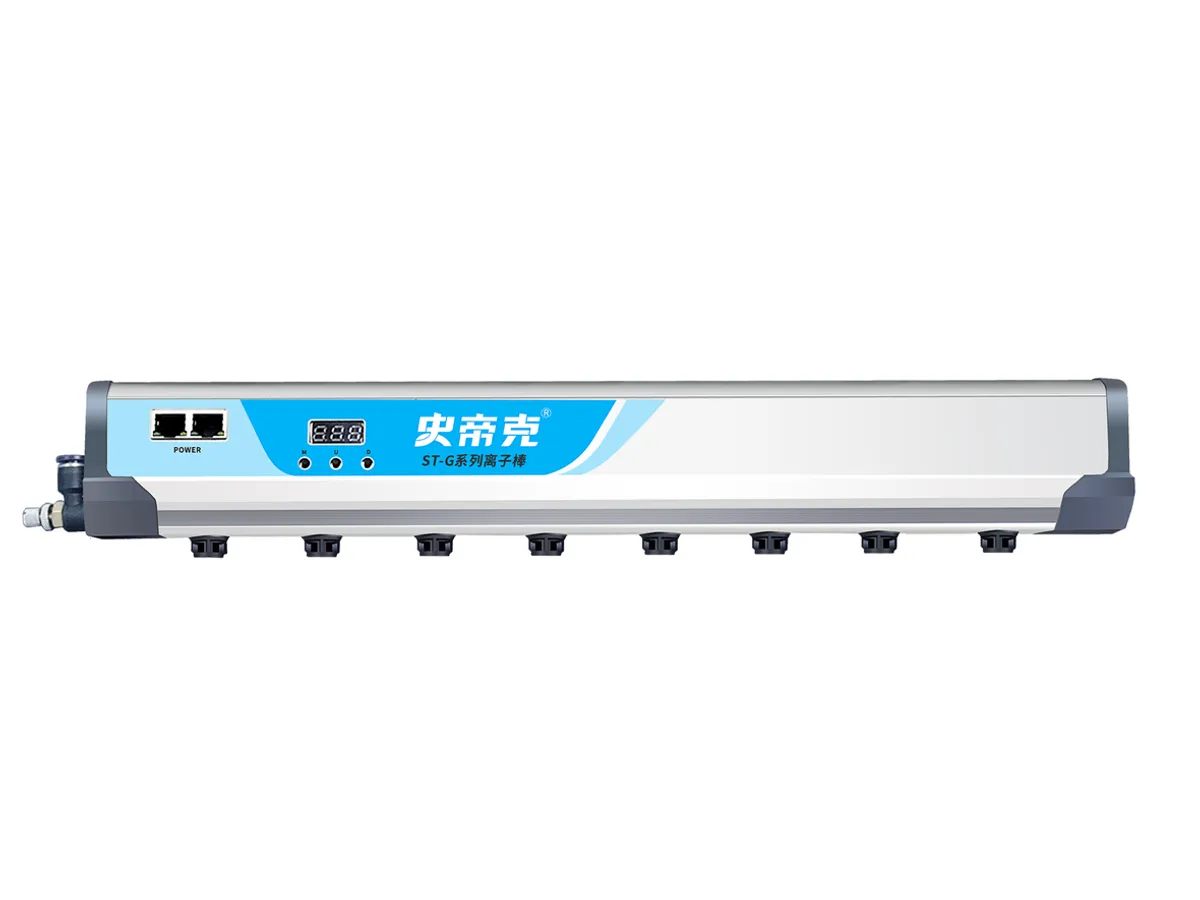
THE SHORT ANSWER
What is an ionizing bar?
An ionizing bar is a static control device that produces positive and negative air ions to neutralize electrical charge on a nearby surface. Its linear shape provides coverage across moving film, sheets, panels, or conveyor lanes without touching the material.
Also called an ionizer bar, ion bar, or static elimination bar, it is especially useful for insulators such as plastic and glass, where grounding alone cannot readily remove surface charge. Powered ionizing bars use a high-voltage supply to generate ions.
New to the technology? Read our guide to what an ionizing bar is and how it works.
Technical background: EOS/ESD Association — Principles of ESD Control.
01 / THE PRACTICAL VALUE
5 benefits of an ionizing bar in production
Start with the process problem. These benefits are most relevant when measurements show that static is contributing to defects or interruptions.
More reliable material handling
Charged film can cling to rollers, sheets can double-feed, and labels can pull out of position. Neutralizing charge before feeding, stacking, or sealing can reduce these static-related interruptions.
What to measureTrack misfeeds, jams, and minutes of downtime at the same line speed.
Cleaner surfaces and fewer contamination defects
Static attracts dust to plastic, glass, and optical film. An ionizing bar reduces that attraction before coating, printing, or lamination. For particles already on the surface, combine ionization with an appropriate cleaning process.
What to measureCompare particle counts, surface rejects, and rework under the same inspection conditions.
Support for ESD-sensitive component handling
Where essential insulating materials remain near sensitive electronics, ionization helps control charge that grounding alone cannot remove. Use it alongside personnel grounding, suitable packaging, and the rest of your ESD control program.
What to measureVerify ionizer performance against the limits set for the parts and process.
Fewer static-related operator shocks
Reducing charge on material near an operator can reduce nuisance static discharges. Investigate the source of shocks and maintain grounding of conductive equipment. Ionization is one part of the control plan.
What to measureRecord where shocks occur and check material charge at those handling points.
Lower process costs when static is the cause
Less scrap, rework, and unplanned stopping can improve operating costs. The return depends on the losses that static actually causes, as well as the installed cost, maintenance time, power, and any compressed-air use.
What to measureEstimate payback using measured monthly savings after ongoing operating costs.
Compare equivalent production runs with the same material, speed, and inspection criteria. Do not assume a fixed defect reduction or longer machine life from installing a bar.
Simple payback (months) = installed cost ÷ net monthly savings. Use consistent USD costs and include maintenance, electricity, and compressed air where applicable.
02 / THE PRINCIPLE
How does an ionizing bar work?
Most powered industrial bars use corona discharge. A high-voltage supply energizes an array of emitter points, creating ions in the surrounding air. The electric field and, on some designs, airflow carry those ions toward the material.
- Generate ions.Emitter points produce positive and negative ions using an AC or DC operating method.
- Neutralize surface charge.A charged surface attracts ions of the opposite polarity, reducing its net charge.
- Check the result.Verify performance at the material, across the working width and at production speed.
The bar does not stop later contact or separation from generating charge again. Position it after a charge-generating step and before the operation affected by static.
Two useful performance measures are discharge time (how quickly a test charge is reduced) and offset voltage, or ion balance (the voltage a test plate settles toward). Neither is the same as the bar’s high-voltage output. See our ionizing bar voltage guide.
03 / UNDERSTAND THE OPTIONS
Types of ionizing bars and other static control methods
Corona ionization includes AC, steady-state DC, and pulsed DC designs. AC changes polarity over its cycle; steady-state DC uses emitters assigned to positive and negative output; pulsed DC delivers the polarities in timed pulses. “Intelligent” describes controls or monitoring features, rather than a separate ionization principle. Features vary by model.
Learn more: Simco-Ion — ionization methods and airflow.
| Method | Typical fit | Selection consideration |
|---|---|---|
| Ionizing bar | Moving webs, sheets, and panels | Active width, mounting distance, and time under the bar |
| Ionizing fan / blower | Benches and localized assembly areas | Airflow coverage and disturbance of small parts |
| Ionizing nozzle / gun | Targeted neutralization or cleaning | Air quality, consumption, and access to the surface |
| Grounding and bonding | People and conductive objects | A suitable conductive path; ordinary insulators still need separate control |
Ionization complements grounding. It does not replace a verified personnel grounding system or the rest of an ESD control program.
04 / APPLICATIONS
Where are ionizing bars used?
- Packaging and printingAddress static-related film cling, sheet misfeeds, and label handling problems before feeding, printing, or sealing.
- Display panels and optical filmReduce charge-driven particle attraction before inspection, coating, or lamination.
- Electronics assemblyControl charge on essential insulating carriers and materials near sensitive components.
- Plastics and textilesEvaluate charge after separation, conveying, or unwinding where it affects handling or cleanliness.
For contamination problems, also consider industrial cleaning equipment. Neutralizing charge and physically removing particles are separate process steps.
05 / BEFORE YOU SPECIFY
How to choose the right ionizing bar
Ask for performance data under conditions close to your own. Supply voltage or maximum working distance alone does not establish whether a bar will solve your problem.
- Material and symptom. Identify the substrate and the defect or handling issue. Measure charge where the problem occurs.
- Active coverage. Match the emitter coverage to the treated width. Overall housing length can differ from active length.
- Mounting space. Record the available distance and nearby grounded metal or obstructions. Supply dimensions in inches or millimeters.
- Production speed. Give normal and maximum speed in ft/min or m/min. The available treatment time must be adequate for neutralization.
- Acceptance criteria. Set discharge-time and ion-balance limits for your process, then verify material charge after installation. Avoid generic “safe voltage” assumptions.
- Environment and utilities. Check contamination, cleanroom requirements, airflow, available power, and access for maintenance. Confirm any required US electrical or hazardous-location approvals for the exact model.
06 / KEEP PERFORMANCE CONSISTENT
Installation, maintenance, and verification
Mount at the point where charge matters
Place the bar after the relevant separation or friction point, before the affected operation, with a clear path from emitters to material. Follow the model’s mounting clearances, grounding, and wiring instructions. Check the left, center, and right of the working width at full line speed.
Inspect emitters and clean according to the manual
Deposits on emitter points can reduce ion output. Isolate power before inspection or cleaning, use only the specified cleaning materials, and allow the unit to dry as instructed. Check cables, emitter condition, and any alarms. Base cleaning intervals on contamination and performance checks rather than a universal schedule.
Verify neutralization, not just power
Use a suitable electrostatic meter to compare material charge before and after treatment with consistent measurement geometry. A charged plate monitor is used to assess ionizer discharge time and offset voltage. Record the test conditions and repeat checks after cleaning, relocation, or changes in material or speed.
Test-method background: EOS/ESD Association — ESD standards and ionization testing.
Do not touch energized emitter points. General-purpose ionizing bars should not be assumed suitable around flammable vapors or combustible dust. Confirm the exact product’s approvals and follow its instructions.
Example manufacturer guidance: Simco-Ion IQ Power HL safety instructions (PDF). This is not a certification for DGSDK products.
07 / PRODUCT OPTIONS
Compare DGSDK ionizing bars
Start with the application focus below, then review the model specifications and confirm suitability for your process.
ST-G
Pulsed AC ionizing bar for general inline static control.
View ST-G specifications WIDE SPANSST-E
High-frequency pulsed DC bar for wide-span applications.
View ST-E specifications FAST-MOVING MATERIALST-F
Pulsed DC bar designed with neutralization speed in mind.
View ST-F specifications08 / QUESTIONS & ANSWERS
Ionizing bar FAQ
Is an ionizer bar the same as an ionizing bar?
Yes. Ionizer bar, ion bar, anti-static bar, and static elimination bar are common names for this product family. Check whether a particular bar is powered or passive, its ionization method, and its tested performance at your working distance.
Which industries benefit from ionizing bars?
Packaging, printing, plastics, textiles, electronics, and display manufacturing use ionizing bars where static affects handling or quality. The best fit depends on a confirmed charge problem, the material, and the time available for neutralization.
Does an ionizing bar remove dust?
It reduces the electrostatic attraction that holds or draws dust to a surface. It does not collect particles. Existing contamination may need air-assisted cleaning, extraction, or a contact cleaner suited to the material.
How close should an ionizing bar be to the material?
Use the working range and mounting clearances specified for the selected model. Confirm performance at the actual distance and production speed. A published maximum range does not guarantee the same neutralization time or ion balance throughout that range.
Does an ionizing bar need compressed air?
Some bars operate without compressed air; others use air assistance to carry ions or help with cleaning. Check the model requirements and include filtration, airflow compatibility, and air consumption in the selection.
How often should an ionizing bar be cleaned?
Follow the manufacturer’s cleaning method and start with a regular inspection schedule suited to the environment. Shorten the interval if emitters become contaminated or measured performance declines. Isolate power before cleaning, then verify performance before returning the bar to service.
Can an ionizing bar prevent fires or be touched while operating?
Do not touch energized emitter points or assume a general-purpose bar is suitable for a hazardous location. Flammable vapor or combustible dust applications require equipment approved for the location and a site-specific safety assessment. Follow the selected product’s installation and maintenance instructions.
How do I check whether my ionizing bar is working?
Compare material charge before and after the bar using a suitable electrostatic meter with consistent measurement geometry. Use a charged plate monitor to evaluate discharge time and offset voltage under the applicable test procedure. Check across the working width and at production speed; a power indicator alone does not verify neutralization.
PLAN YOUR INSTALLATION
Match the bar to your line.
Share your material, working width, line speed, available mounting distance, and the static problem you want to solve. We can help narrow down the product and installation options.