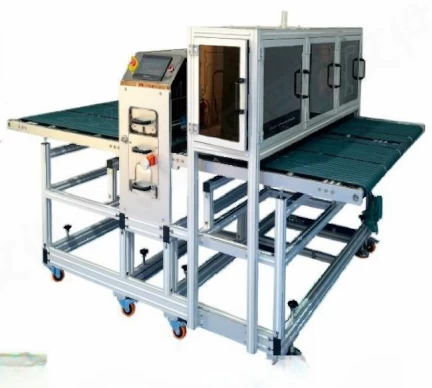
Part 1: What Is a Mobile Phone Cover Glass Roller Dust Cleaner?
Q1: Why is a roller dust cleaner necessary in mobile cover production?
Tiny dust particles and fibers on glass, ceramic, or plastic phone covers can cause pinholes in coating, printing defects, and direct yield loss. A roller dust cleaner removes surface contaminants through physical adhesion. With controlled light contact or low-pressure design, it can clean the surface without scratching or damaging the cover.
Q2: How is it different from traditional static dust removal?
Static dust removal mainly reduces electrostatic attraction, but it may be less effective for micron-level particles and can leave residual charge if ion balance is not controlled. A roller dust cleaner physically captures particles from the surface, making it more suitable for fragile materials such as ceramic covers. Compared with general-purpose equipment, DGSDK roller cleaners are designed to balance adsorption efficiency with surface protection for precision cover glass processes.
Q3: What are the core components?
The main components include adhesive cleaning rollers, a pressure adjustment system, a static elimination device, and a transport mechanism. Roller material, such as silicone or PU, and pressure control are the two factors that most directly affect cleaning performance and surface safety.
Q4: Do different cover materials require different cleaner configurations?
Yes. Glass covers require soft rollers to prevent scratches. Ceramic covers need strong particle capture under low pressure. Ultra-thin covers below 0.5mm require adaptive pressure control to prevent deformation. DGSDK can configure the solution around material type, cover thickness, and production line speed.
Q5: How can cleaning performance be quantified?
Common indicators include residual particle level and yield improvement. In many production cases, professional roller cleaning equipment can reduce surface dust residue by more than 60% and improve coating yield by 15%-20%. Actual improvement depends on baseline contamination, cleanroom conditions, material static behavior, and process parameters.
Part 2: Core Implementation Steps from Selection to Maintenance
Q1: Which parameters matter most during equipment selection?
Four parameters deserve priority: roller material should be wear-resistant and residue-free; pressure range should match cover thickness, for example 0-5N; static elimination should keep ion balance within roughly ±10V where the process requires it; and transport speed should synchronize with the line, such as 0-20m/min. DGSDK equipment supports adaptive pressure adjustment for mobile cover production requirements.
Q2: What are the key commissioning points?
Keep the roller parallel to the cover surface so pressure remains uniform. Calibrate ion balance before production. Synchronize cleaner speed with upstream and downstream equipment to avoid pauses or jams. Finally, test each cover material separately and record the best pressure, speed, and static elimination settings.
Q3: What matters most in consumable management?
Replace adhesive rollers based on actual usage, often evaluated every 8-12 hours in high-frequency production. Use compatible consumables to avoid adhesive residue. Store rollers away from moisture and direct sunlight. DGSDK dedicated adhesive rollers are designed for stable service life and low residue risk.
Q4: How can operators get started quickly?
Operators should first understand the panel controls for pressure, speed, and static elimination. Then they should run trial production according to the operation manual and record the best settings for each cover type. Training should also cover abnormal conditions such as roller jamming, speed mismatch, ionizer failure, and adhesive residue.
Q5: Which parts need regular inspection?
Inspect the roller surface for damage or residue, verify pressure sensor accuracy, check ionizer output, and listen for abnormal noise in the transport mechanism. For continuous high-speed lines, record roller runtime, cleaned area, and abnormal downtime to support preventive maintenance.
Part 3: Adaptation Points for Different Production Scenarios
Q1: What is difficult about ultra-thin covers below 0.5mm?
Ultra-thin covers are easily pressed, bent, or deformed. The cleaner should use low-pressure adaptive contact and stable transport speed to reduce vibration and instant impact. If the equipment supports ultra-thin cover cleaning, pressure control and stable conveying are the foundation of low-damage operation.
Q2: How should curved cover glass be cleaned?
The challenge is incomplete contact on curved areas, which can leave uncleaned zones. Multi-roller combinations or arc-shaped rollers can improve contact coverage. For 3D curved covers, the curvature, feeding direction, and pressure distribution should be tuned together.
Q3: What matters on high-output lines, such as 1000 pieces per hour?
High-output lines need continuous running capability and fast consumable replacement. Focus on quick roller replacement, abnormal alarms, speed synchronization, and easy internal cleaning. DGSDK equipment supports quick roller changes to reduce downtime in high-volume production.
Q4: What should be considered for plastic phone covers?
Plastic covers are softer and more prone to static charge. Use lower-tack rollers to avoid adhesive marks or pressure imprints, and strengthen static elimination to prevent re-attraction after cleaning. If the plastic cover has a coating, verify compatibility between the coating and roller material before mass production.
Q5: How can ceramic covers be cleaned without edge chipping?
Ceramic covers are brittle, especially around the edges. Keep roller pressure around 2-3N where the process allows, use soft silicone rollers, and avoid hard contact or sudden impact. Transport guides should remain smooth so the cover edge does not collide with rails or roller ends.
Part 4: Troubleshooting and Optimization Tips
Q1: What should be checked when cleaning performance drops?
Check whether the roller has aged or become saturated with particles, and replace it if needed. Adjust pressure to confirm it is neither too low for capture nor too high for stable contact. Recalibrate the static eliminator and clean internal dust accumulation to prevent secondary contamination.
Q2: What should be done if adhesive residue appears on the cover?
Replace the roller with a residue-free compatible consumable, reduce pressure to avoid over-compression, and inspect whether the roller is damaged, aged, or contaminated by solvent. If residue appears repeatedly on the same batch, also check upstream cleaning fluid, protective films, and handling fixtures.
Q3: How should jamming or feeding pauses be handled?
First check whether the gap between roller and cover is uniform. Then verify speed synchronization with the production line, remove foreign matter from the transport system, and inspect whether covers are warped. For frequent warped covers, floating guides or adaptive pressure structures are more effective than simply increasing pressure.
Q4: How can machine service life be extended?
Keep the machine interior clean, store consumables correctly, avoid long-term overload operation, and maintain bearings, drive components, pressure systems, and ionizers according to the manual. High-speed lines should use a daily inspection checklist and a spare-parts plan.
Q5: What if static elimination failure causes secondary dust attraction?
Calibrate ion balance first, then check power supply, discharge pins, and working distance. If needed, increase ionization time or intensity. If residual voltage remains high after cleaning, add another ionizing unit near the exit to reduce re-adsorption risk.
Conclusion
Successful implementation of a mobile phone cover roller dust cleaner depends on balancing adaptability and stability. Correct equipment selection, careful commissioning, and disciplined consumable management are what turn a cleaning station into a real yield-protection checkpoint.
"A roller dust cleaner for mobile phone covers is not just a surface cleaning device; it connects clean manufacturing, static control, and yield improvement in one process step."
Need a roller cleaning solution for mobile cover production?
DGSDK engineers can help evaluate roller material, pressure range, static elimination, and line-speed adaptation for glass, ceramic, plastic, ultra-thin, and curved cover applications.