Part 1: Core Value & Function in CCL Production
What is a CCL multi-layer board roller adhesive cleaner, and what does it do?
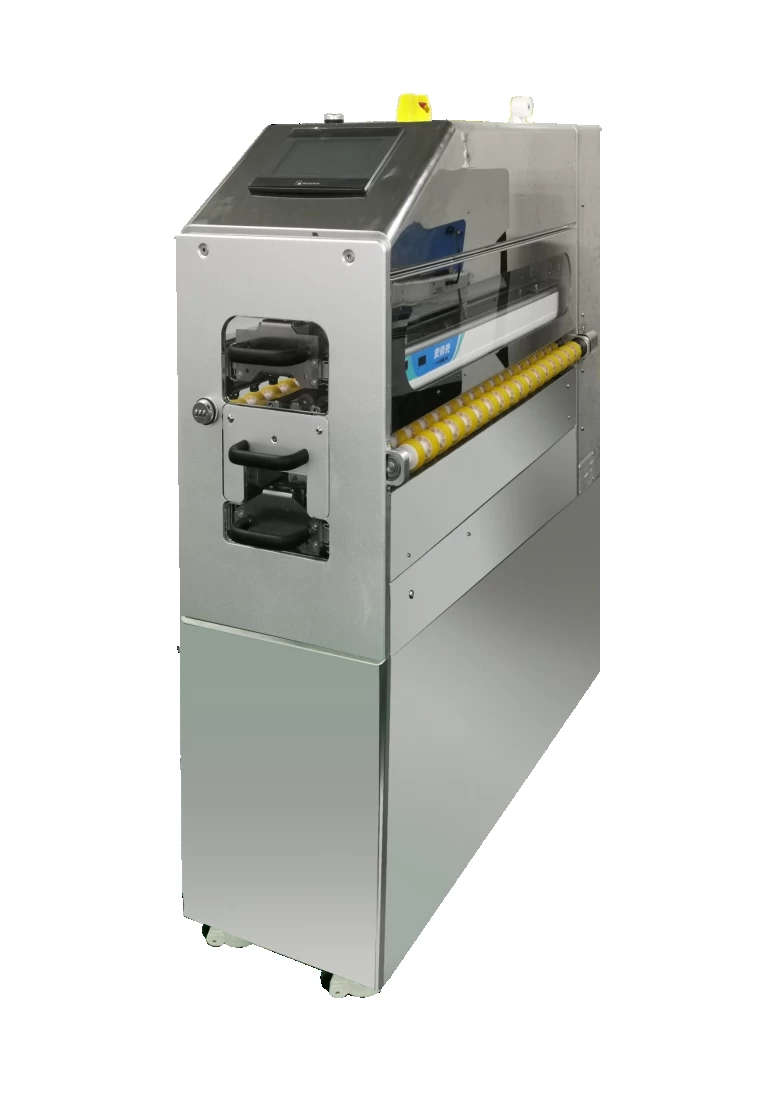
A CCL multi-layer board roller adhesive cleaner is a dedicated surface cleaning machine that uses adhesive-coated cleaning rolls to capture and remove dust, fiber fragments, and electrostatically attracted particles from the substrate surface during the multi-layer board manufacturing process. The cleaning roll contacts the substrate surface under controlled pressure, transferring loose contamination from the board surface to the roll surface, which is periodically refreshed by advancing a clean adhesive paper section.
In the CCL production context, the machine operates at one or more points in the process sequence — typically before press lamination and after cutting — where surface contamination levels are highest and the downstream consequence of contamination is most severe. A particle or fiber fragment trapped at the laminate interface during press lamination creates a void or delamination defect that propagates through subsequent drilling, plating, and etching steps. The roller cleaner's function is to ensure that the substrate surface entering the lamination press is at the cleanliness level required to achieve the target lamination bond quality and void rate.
What is the core production value of a roller cleaner in CCL multi-layer board manufacturing?
The core production value operates through three mechanisms. First, yield rate improvement: press-lamination voids and delamination defects caused by particulate contamination are eliminated at the source. For a production line with a contamination-related void rate of 2–5%, proper surface cleaning upstream of lamination reduces this defect category significantly — the exact reduction depends on the baseline contamination load and the cleaning efficiency of the system installed.
Second, rework and downtime reduction: contamination-induced lamination defects are typically detected at electrical test or inner-layer inspection, long after the contamination event. Each defective panel requires either rework — which is time- and cost-intensive for multi-layer constructions — or scrap. Cleaning upstream of lamination converts a downstream quality cost into an upstream process cost, which is significantly cheaper per panel. Third, direct cost reduction: the consumable cost of a roller cleaner operating continuously is predictable and manageable; the cost of undetected lamination voids is not. Managing contamination proactively rather than reactively produces a lower total cost over time.
How does a roller adhesive cleaner differ from ion blowers and other cleaning methods used in CCL production?
Roller adhesive cleaners and ion blowers address different contamination categories and must be understood as complementary rather than interchangeable. A roller adhesive cleaner physically captures particulate contamination — dust, fiber, debris — from the substrate surface through direct adhesive contact. It is highly effective at removing particles that are resting on or weakly adhered to the surface, including particles that are held by electrostatic charge rather than by any chemical or mechanical bond.
An ion blower neutralizes surface electrostatic charge, which reduces the rate at which new particles are attracted to the substrate surface from the ambient environment, and releases particles that are held by strong electrostatic adhesion. However, an ion blower does not physically remove particles — it modifies the adhesion force holding them, and relies on gravity or airflow to move the released particles away from the surface. In practice, ion blowers used without a simultaneous mechanical capture mechanism (such as a roller or vacuum extraction) can release particles from the substrate surface into the ambient air near the substrate, where they may re-deposit. For CCL lamination applications, the combination of roller adhesive capture and static charge suppression provides the most effective and reliable surface preparation.
At which process stages in CCL multi-layer board production should a roller cleaner be positioned?
The four process stages where roller cleaner installation produces the highest yield impact are: after cutting (where cutting dust and fiber fragments are generated at high volume and must be removed before the cut panels enter any subsequent process step); before inner-layer lamination (where particle contamination at the prepreg-to-core interface creates delamination voids that are electrically and mechanically significant); before outer-layer lamination (where contamination creates surface finish defects and plating adhesion problems); and before AOI or automated optical inspection (where surface contamination generates false defect calls that reduce inspection throughput and increase rework).
In reel-to-reel CCL production, the cleaner is positioned inline before the lamination or inspection station, synchronized to the web speed. In sheet-fed multi-layer production, cleaners are typically positioned at individual process entry points. The priority sequence for installation is: pre-lamination first (highest yield impact per unit), then post-cutting (highest contamination generation rate), then pre-inspection (throughput improvement). When budget constraints require phased installation, this sequence maximizes early return on investment.
What specific requirements do high-frequency and automotive-grade CCL substrates impose on roller cleaner performance?
High-frequency and automotive-grade CCL substrates impose three requirements that standard roller cleaners may not meet. First, zero ionic contamination: cleaning roll adhesive formulations that leave ionic residues on the copper surface will degrade high-frequency signal transmission by increasing surface conductivity at frequencies where skin depth concentrates current at the copper surface. The cleaning roll formulation must be verified for zero ionic contamination on bare copper, using ion chromatography measurement rather than simple visual inspection.
Second, zero copper surface damage: high-frequency copper foil — particularly low-profile or reverse-treated foil — is engineered to a specific surface roughness profile that determines high-frequency signal loss. Cleaning roll contact pressure or roll surface hardness that abrades this profile degrades signal performance in a way that is not visible to optical inspection and only manifests at electrical characterization. The cleaning roll must maintain contact pressure below the threshold that alters the copper surface roughness profile. Third, complete particle removal to sub-micron levels: automotive and high-frequency PCBs have finer line widths and tighter layer-to-layer registration tolerances than standard commercial PCBs, making them more sensitive to small particles that would be inconsequential on standard material. Verify cleaning performance with particle counter measurement on actual substrate material.
Part 2: Selection Strategy
What are the critical performance metrics for selecting a CCL multi-layer board roller cleaner?
Four metrics determine whether a roller cleaner is performing at the level required for CCL multi-layer production. Cleaning efficiency specifies the percentage of target particles removed from the substrate surface at production line speed — this should be measured on actual CCL substrate material using a particle counter, not estimated from general specifications. The relevant particle size range for CCL lamination applications is 1–50 µm; particles in this range are large enough to create lamination voids but small enough to be invisible to visual inspection.
Substrate format compatibility covers the board thickness range, width range, and warp tolerance the machine can process without jam events or damage — both ultra-thin CCL (below 0.1 mm core thickness) and high-warp panels require specific design features that standard machines do not provide. Static elimination performance specifies the residual surface voltage after the cleaning pass; for CCL applications, below 100 V is the typical target, verified at the substrate exit under production conditions. Consumable service life specifies the substrate area cleaned per roll set before replacement is required; this drives the ongoing operating cost and should be verified with data from comparable installations rather than from laboratory testing.
How should a manufacturer assess whether a roller cleaner is compatible with their existing production line?
Production line compatibility requires evaluation of three parameters that catalog specifications typically do not address. First, throughput matching: the cleaner's maximum processing speed must meet or exceed the rated throughput of the production line at its planned operating capacity, not its current capacity. A cleaner that becomes the throughput bottleneck when the line is upgraded is obsolete before it is fully amortized.
Second, physical integration: the cleaner's footprint, height envelope, and entry/exit conveyor height must be compatible with the physical constraints of the installation location — including space for roll change access, which is frequently overlooked during installation planning. Third, upstream and downstream interface compatibility: the cleaner's conveyor speed control must interface with the line's master speed control system for inline installation, or with the transfer system for standalone installation. For inline installation, verify that the cleaner's tension control (for reel-to-reel) or registration accuracy (for sheet-fed) meets the requirements of the adjacent process equipment. Request a site survey from the supplier before equipment specification is finalized.
What performance requirements must a roller cleaner meet for ultra-thin CCL board production?
Ultra-thin CCL cores — typically 0.05–0.1 mm — have three mechanical characteristics that require specific cleaner design features. Low bending stiffness means that transport tension must be carefully controlled; tension non-uniformity across the board width produces warp or crease deformation that is irreversible and scraps the panel. The cleaning machine must maintain tension uniformity within ±5% across the panel width throughout the cleaning pass.
Low contact pressure tolerance means that the cleaning roll contact force must be calibrated to achieve effective particle capture without creating pressure marks or surface deformation. The correct specification is contact force per unit area (in Pascals), not total roll force — a narrow roll with high total force and a wide roll with low total force can have very different contact pressures at the same roll width. Zero-damage cleaning requires cleaning roll formulations that are mechanically compatible with ultra-thin copper foil surface treatment. Request verified ultra-thin board test data from the supplier — specifically, surface inspection at the same magnification used in production, not a general "suitable for thin material" claim.
How should warped CCL panel jamming problems be addressed when selecting a roller cleaner?
Warped CCL panels jam in standard roller cleaners because the fixed entry geometry — the gap between the entry guide and the cleaning roll — cannot accommodate panels whose leading edge is elevated or depressed relative to the nominal board plane. A panel with 3 mm of warp across its length may have a leading edge that is 1–2 mm above or below the nominal entry height, which is sufficient to catch on the entry guide and fold rather than enter the cleaning nip.
The engineering solution is an adaptive entry geometry that actively adjusts to the board's leading edge height as it enters. This is implemented as a spring-loaded or pneumatically controlled entry guide that moves vertically to follow the board surface rather than presenting a fixed height constraint. The critical specification is the warp accommodation range — the maximum bow value the machine can accept without jam — which should be tested with actual warped panels from your production mix, not with flat test panels. Additionally, the cleaning roll pressure mechanism must maintain consistent contact across the full board surface when the board is warped, which requires a compliant rather than rigid roll mounting system.
What framework should guide the final selection decision when comparing roller cleaner suppliers?
Supplier comparison should be structured around three evaluation dimensions, weighted in the order presented. First, application specificity: does the supplier's product and technical team demonstrate specific knowledge of CCL multi-layer board cleaning requirements — the ionic contamination sensitivity of high-frequency copper, the warp and thickness range of production CCL formats, and the contamination load profile of cutting versus lamination stations? Generic cleaning equipment suppliers often cannot address these requirements with the specificity the application demands.
Second, production validation evidence: can the supplier provide particle count and surface quality data from installations in comparable CCL production environments — not from paper qualification tests? Reference customers in the CCL or multi-layer PCB industry who can speak to field performance are more valuable than laboratory certification documents. Third, service capability: does the supplier maintain local technical support, consumable stock, and spare parts availability in your manufacturing region? A supplier who provides strong equipment at purchase but cannot support it in production delivers a declining total value over the equipment lifetime. Weight field service capability as heavily as equipment specification in the final decision.
Part 3: Efficiency Optimization
What is the systematic approach to optimizing roller cleaner cleaning performance?
Cleaning performance optimization requires a three-parameter approach that addresses the machine, the consumables, and the process context simultaneously. Machine parameter optimization covers roll contact pressure and transport speed — both must be matched to the specific substrate being processed. Contact pressure that is too low produces insufficient particle capture; pressure that is too high risks surface damage on sensitive copper finishes. Transport speed that exceeds the roll's effective capture rate leaves particles on the surface; speed that is too slow reduces throughput unnecessarily. Establish baseline pressure and speed settings for each substrate type processed on the line, and document these in a parameter table that is referenced during product changeover.
Consumable management is the second parameter. Cleaning roll effectiveness declines gradually as the adhesive surface becomes saturated with captured particles; the relationship between roll usage (in square meters cleaned) and cleaning efficiency is a predictable curve, not a step function. Establish a roll replacement schedule based on actual particle count measurements at defined usage intervals on your production substrates, rather than on a fixed time or shift interval. This data-driven replacement schedule is typically more economical than time-based replacement and more reliable than waiting for visible performance degradation. The third parameter is static charge management — ensuring that the ionization system is functioning within specification at the start of every shift, using a calibrated electrostatic meter, not by visual inspection of the ionizer.
What are the most effective strategies for reducing roller cleaner downtime?
Unplanned downtime in roller cleaner operation has two primary causes: consumable exhaustion (running the cleaning roll past its effective service life until cleaning failure occurs) and mechanical component wear (bearing failure, roll drive system wear) that is not identified before it causes a production stop. Both are preventable with a planned maintenance approach that is based on actual usage data rather than calendar intervals.
For consumable management, implement a roll usage tracking system that records substrate area processed per roll set and generates a replacement reminder before the roll reaches the end of its effective service life. This requires knowing the effective service life of your rolls for your substrate type — data that should come from the supplier for comparable applications and be verified during initial installation commissioning. For mechanical component maintenance, establish inspection intervals for bearings, drive belts, and roll mounting components based on the manufacturer's wear data for your operating speed and substrate type. Replace components at the inspection interval limit rather than at failure. The cost of planned component replacement is a fraction of the cost of an unplanned production stop.
How should a roller cleaner be integrated with upstream and downstream equipment to maximize overall line efficiency?
Line efficiency integration operates at three levels. Speed synchronization ensures that the roller cleaner's transport speed tracks the line's master speed controller in real time, so that speed changes during startup, shutdown, and product transitions do not create gaps in cleaning coverage or tension events that damage the substrate. This requires a speed control input on the cleaner that accepts a signal from the line master — verify this interface before specifying the equipment.
Data integration allows the cleaner's operating data — roll usage counters, transport speed logs, ionization system status — to be shared with the line's production management system. This enables condition-based maintenance decisions to be made from centralized production data rather than requiring separate manual inspection of the cleaner. Cross-contamination control is the third integration level: the cleaner's effectiveness is limited by the cleanliness of the transport surfaces (belts, rollers) that carry the substrate before and after the cleaning station. Coordinate belt cleaning or replacement schedules with the roller cleaner's consumable replacement schedule to prevent clean substrates from being re-contaminated by dirty transport surfaces downstream of the cleaner.
How can the consumable cost of a roller cleaner be systematically reduced without compromising cleaning performance?
Consumable cost reduction requires distinguishing between legitimate cost reduction and false economy. Legitimate cost reduction involves using actual performance data to extend roll replacement intervals to the maximum point where cleaning effectiveness remains above the required threshold — measured by particle count, not by visual roll inspection. Many operations replace rolls on a fixed shift interval that is significantly shorter than the actual effective service life, producing higher consumable cost without any quality benefit.
False economy involves extending roll use past the effective service life to defer consumable cost, or using lower-specification consumables that are incompatible with the substrate being cleaned. Both approaches produce contamination events that cost far more than the consumable saving — a single lamination void caused by inadequate cleaning in a 20-layer PCB represents more material and process cost than dozens of roll sets. The correct framework is to measure the cost per square meter of substrate cleaned per roll set, including the yield impact of any contamination events attributable to cleaning, and optimize the roll replacement interval against this total cost metric rather than against the consumable unit cost alone.
How can secondary contamination — where the cleaning machine itself re-deposits particles — be prevented?
Secondary contamination in roller cleaner operation has two distinct mechanisms. First, particle rebound from saturated roll surfaces: when a cleaning roll's adhesive surface reaches saturation, its capture efficiency drops sharply, and particles that contact the roll but are not captured may bounce off and deposit on a different location of the substrate surface. This is prevented by maintaining roll replacement intervals within the effective service life range — well before saturation occurs. The indicator is a particle count measurement on the cleaned substrate, not visual roll inspection.
Second, particle re-suspension from internal machine surfaces: dust and fiber captured by the roll can accumulate on the machine's internal surfaces — guides, covers, transport rollers — and be re-deposited on the substrate during subsequent production. This is prevented by including machine interior cleaning in the maintenance schedule, with particular attention to any surface that is adjacent to the substrate path. Closed-loop designs that contain captured particles within the roll system rather than allowing them to deposit on machine surfaces are preferable for high-contamination-load applications like post-cutting cleaning in CCL production. When evaluating equipment, assess the machine's internal contamination containment design as a selection criterion.
Part 4: Fault Diagnosis & Corrective Action
How should a sudden drop in roller cleaner cleaning performance be diagnosed and resolved?
A sudden drop in cleaning performance — measured as an increase in particle count on the cleaned substrate surface — has three common causes with distinct diagnostic signatures. Roll adhesive degradation produces a gradual, progressive performance decline that accelerates after the roll passes its effective service life; if the performance drop is sudden rather than gradual, the roll is typically not the primary cause. Verify by comparing current roll usage against the expected service life curve; if the roll is well within its expected service life, look elsewhere.
Static elimination system failure produces a specific particle pattern: particles that are uniformly distributed across the substrate surface rather than concentrated at points where the roll contacts the surface. When the ionizer fails, charged particles that were being neutralized and released from the substrate are instead held by electrostatic force after the roll passes, and new particles from the ambient environment are attracted to the charged surface. Verify ionizer function with an electrostatic meter before checking mechanical components. Transport speed mismatch — the line speed has changed but the cleaner speed has not been updated — produces a pattern of cleaning non-uniformity correlated with the speed change event. Check the speed settings and the speed control interface.
How should frequent jamming of warped CCL panels in the roller cleaner be resolved?
Frequent jamming of warped panels in an installed roller cleaner indicates that the warp accommodation range of the current entry geometry is insufficient for the current production panel mix. This occurs when panel warp increases due to a material change, a process parameter change upstream (lamination temperature, cooling rate), or a seasonal humidity change that affects core moisture content and warp behavior.
The immediate corrective action is to reduce the entry guide height sensitivity — if the entry guide is spring-loaded, reducing the spring preload increases the guide's accommodation range. If the entry guide is fixed, replacing it with a floating guide that moves in response to the panel's leading edge height resolves the issue mechanically without requiring equipment replacement. For production panels with extreme warp (above 5 mm bow across the panel length), an entry pre-conditioner — a set of low-friction conforming guides positioned before the cleaning nip — that smooths the panel profile before it reaches the cleaning roll is the most effective engineering solution. Document the warp range of your current production panels and verify that the cleaning machine's accommodation range exceeds the 95th percentile warp value in your mix.
How should electrostatic-induced particle rebound — where cleaned panels continue to attract dust after cleaning — be addressed?
Electrostatic particle rebound after cleaning is caused by insufficient ion balance at the cleaning machine exit. When the ionization system is functioning correctly, the substrate exits the cleaning station with a residual surface voltage below the threshold that attracts ambient particles fast enough to cause measurable re-contamination before the substrate reaches the next process station. When the ionizer is degraded or positioned incorrectly, the substrate carries sufficient residual charge to re-attract particles during the transport between the cleaner exit and the next station.
Diagnosis: measure the substrate surface voltage at the cleaner exit using a non-contact electrostatic meter. A reading above 200–300 V indicates that the ionization system is not performing to specification. Check the ionizer for needle contamination (the most common cause of performance degradation in AC ionizers), verify supply voltage and frequency, and check that the ionizer is positioned at the specified distance from the substrate. If the ionizer is functioning within specification but residual voltage is still above target, the ionizer output is insufficient for the substrate type or ambient humidity conditions — either add a second ionizer or upgrade to a higher-output model. Do not increase cleaning roll contact pressure in response to this symptom; it addresses the wrong variable.
How should adhesive residue buildup on the cleaning roll surface be managed?
Adhesive residue on the cleaning roll surface accumulates when the roll contacts substrate contamination types that are not effectively captured by the adhesive formulation — typically oil contamination or chemical residues from upstream process steps. Unlike particle contamination, which is captured and transferred to the roll without affecting the roll surface, oil and chemical contamination partially dissolves or swells the roll adhesive, reducing its particle capture effectiveness and potentially transferring adhesive residue to subsequent substrate surfaces.
The primary corrective action is to identify and eliminate the contamination source upstream of the cleaner — oil contamination typically originates from conveyor lubrication, cutting tool lubrication, or storage handling. If the contamination source cannot be eliminated, the roll formulation must be changed to a chemically resistant variant that maintains its capture effectiveness in the presence of the specific contaminant. Never use cleaning solvents on a production cleaning roll without verifying compatibility with the roll formulation first — incompatible solvents can permanently degrade the adhesive layer. Maintain a log of contamination events and roll performance changes to identify whether the issue is episodic (related to specific batches or process conditions) or systematic (requiring a formulation change).
What are the causes and corrective actions for excessive operating noise in a roller cleaner?
Elevated operating noise in a roller cleaner has three primary mechanical causes with distinct frequency characteristics. Bearing wear produces a continuous broadband noise that increases with bearing temperature during operation — a bearing that is noisier after 20 minutes of operation than at startup is developing fatigue. The corrective action is bearing replacement according to the manufacturer's replacement interval; do not operate to audible bearing failure, as bearing seizure in a production machine causes a significantly longer downtime event than planned replacement.
Roll imbalance produces a rhythmic noise at a frequency that corresponds to the roll rotation speed — a tonal sound that varies in pitch with line speed. This is caused by non-uniform roll adhesive thickness, roll core damage, or contamination accumulation on one side of the roll. Replace the roll and verify that the noise disappears; if it persists, the roll mounting bearing housing is worn and requires service. Drive system noise — belt slap, gear mesh frequency, or coupling misalignment — produces noise at the drive cycle frequency rather than the roll rotation frequency. Identify the noise source by briefly stopping each drive component in sequence and correlating when the noise stops with which component was stopped. Address the root cause rather than applying sound-deadening material; abnormal drive noise indicates a mechanical condition that will progress to failure if unaddressed.
Summary
Roller adhesive cleaner selection and optimization for CCL multi-layer board production is a process engineering decision with direct impact on press-lamination yield, line OEE, and total operating cost. The core principle across all four areas covered in this guide is the same: effectiveness depends on matching the equipment specification, consumable formulation, and operating parameters to the actual substrate type, contamination profile, and process-stage requirements of your specific production line — not to a generic specification that may perform adequately under ideal conditions but drifts in the real production environment.
Selection decisions that focus on initial purchase price while underweighting application specificity, consumable service life, and supplier service capability consistently produce higher total cost of ownership than decisions that weight these factors appropriately. The optimal selection is the machine that minimizes the sum of lamination-void rework cost, consumable cost, downtime cost, and service cost over the equipment's operational life — not the machine with the lowest purchase price or the most impressive specification table.
"The right roller cleaner for CCL production is not the cheapest one, nor the one with the most features — it is the one whose cleaning performance, substrate handling, and static control are precisely matched to your lamination process requirements and verified on your actual production material."
Need a Roller Cleaner Configured for Your CCL Production Line?
DGSDK engineers work with CCL and multi-layer PCB manufacturers to specify cleaning systems matched to substrate format, contamination profile, and process stage — from ultra-thin core cleaning to high-frequency copper protection. Share your panel specifications and key quality challenges for a direct technical assessment.